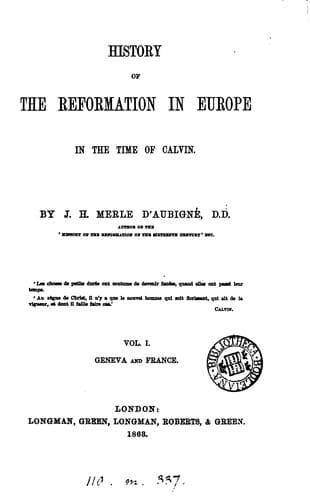
History of the Reformation in Europe in the Time of Calvin, Vol. 6 (of 8)Merle d'Aubigné, J. H. (Jean Henri)
History
History of the Reformation in Europe in the Time of Calvin, Vol. 6 (of 8)
Merle d'Aubigné, J. H. (Jean Henri)
Reformation
that which was pronounced by contemporaries.
CHAPTER XI.
CALVIN AND FAREL PREACH IN SPITE OF THE PROHIBITION BY THE
COUNCIL.--THEY ARE BANISHED FROM GENEVA.
(EASTER, 1538.)
[Sidenote: APPROACH OF THE CRISIS.]
The crisis was approaching. The danger was increasing. Geneva was
in one of those perilous but decisive moments in which some sudden
change takes place, whether for better or for worse. The population
was getting more and more excited. The news that the ministers would
not celebrate the supper in Geneva raised irritation to the highest
pitch. All explanations were useless; many people would not listen to
anything; anger had stopped their ears. It is said that in the evening
the streets were in an uproar, and that bands of factious men were
shouting against the ministers. It is even added that a masquerade had
been organized for the purpose of presenting a parody of scenes from
the Gospel. We are not sure that the libertines went to that length;
but there was during the evening a great agitation in the town, as the
next day too plainly showed. These scenes of tumult greatly grieved
Calvin. If he turned his thoughts to the past, the great sorrows
which he had already borne in Geneva appeared to him again; and he
foresaw that those which were approaching would be more bitter still.
Interfered with in the preaching of the Word, in the administration of
the sacraments, in the maintenance of apostolical discipline and in
the organization of the Church (the council refused its consent to the
division of the town into parishes, a measure which would have greatly
facilitated the discharge of pastoral duties, and have promoted the
good of families), what was he to do? ‘I confess,’ he wrote, ‘that the
first letters by which the senate endeavored to turn aside my will
from the right path struck me a heavy blow.[629] I saw that I was thus
again plunged into the distresses from which I had hoped that I was
delivered by the great goodness of God. When I accepted the government
of this Church, in conjunction with my excellent and most faithful
colleague Farel, I applied myself in all good conscience to seeking
out the means by which it might be maintained; and although it was for
me a very laborious charge, I never thought of abandoning the place.
I considered myself as set by the hand of God at a post from which
I could not withdraw. And nevertheless, if I were to tell the least
part of the cares, or rather of the miseries, which we were forced
to endure throughout a whole year, I am sure that you would think it
incredible.[630] I can assure you that not a day has passed in which I
did not ten times wish for death.’[631] This Easter eve, when he was on
the point of exposing himself to the greatest griefs, while giving unto
God the honor which is due to him, was doubtless one of those days. He
must drink the cup of the people’s wrath. He, the timid scholar, as he
Public-domain text, read in full here on John Shaqi.
Reviews
Reviews
No reviews yet
Be the first to share your thoughts on this work.
Elsewhere in the archive
Join the Discussion
Join the discussion
Sign in to leave a comment or review.
Sign InorCreate an account