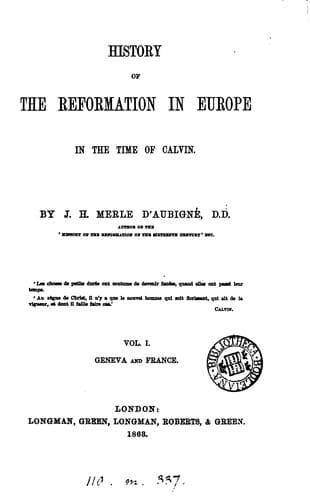
History of the Reformation in Europe in the Time of Calvin, Vol. 6 (of 8)Merle d'Aubigné, J. H. (Jean Henri)
History
History of the Reformation in Europe in the Time of Calvin, Vol. 6 (of 8)
Merle d'Aubigné, J. H. (Jean Henri)
Reformation
declares that he always had been, must now face these furious men. But
one thought gave him strength; it is the will of God, and his will must
be done.
[Sidenote: EASTER SUNDAY.]
Easter Sunday dawned. From early morning great agitation prevailed
in the town. The adversaries and friends of the reformers were both
troubled, but in different ways. The former were impatient to see
if they would really preach notwithstanding the prohibition of the
council, and to hear what they might have to say. The latter also were
eager to go to divine service, either from a sentiment of piety or in
order to defend the ministers in case, as some expected, there should
be any disturbance in the churches. The movements of the multitude,
the groups which were forming at various points, the violent speeches
which were uttered from time to time, all were calculated to inspire
fear. In timid souls there was also an inward trouble, an anxiety, and
a heart-ache, inevitable under circumstances so grave. Men, women,
and children, the roar of the crowd, and the confused voices of the
people, filled the streets. Strange things were fancied, evil reports
were circulated. One would almost have said, seeing the general stir,
that some one was going to be led to execution. The crowd was drifting
towards the places of execution. The inhabitants of the right bank
betook themselves to the church of St. Gervais, in which Farel was to
preach; those of the left bank and of the upper part of the town to the
cathedral of St. Peter, where Calvin would preach. They entered the
doors and filled the churches. The friends of the reformers took their
places in general about the pulpit. Their adversaries, distributed
over all parts of the building, and exchanging bold words with each
other, asked themselves whether it was not their duty to aid the
magistrate and prevent the ministers from speaking. The district on the
right bank was that in which most of the opponents of the ministers
lived. Probably some of their most violent enemies had come from
other quarters to hear Farel, whose presence was less imposing than
Calvin’s, and with whom they were more familiarly acquainted. The brave
evangelist had not ceased for some years lavishing his powers for the
good of Geneva, and for this they meant to pay him on this day. Farel
appeared, entered the pulpit, and at the sight of him considerable
excitement was manifested by the audience. No attempt, however, was
made to close his mouth. The preaching of this popular orator at the
present moment was a spectacle which interested them as much as or even
more than any other. The prayer and the hymns being over, the discourse
began. Farel, with his intrepid heart, his fervent spirit, his strong
convictions, and his power of impressing and carrying away his hearers,
did not conceal the truth. Without dwelling on the question of bread,
which he declared was a secondary matter, he spoke of the holiness of
the supper.
Public-domain text, read in full here on John Shaqi.
Reviews
Reviews
No reviews yet
Be the first to share your thoughts on this work.
Elsewhere in the archive
Join the Discussion
Join the discussion
Sign in to leave a comment or review.
Sign InorCreate an account