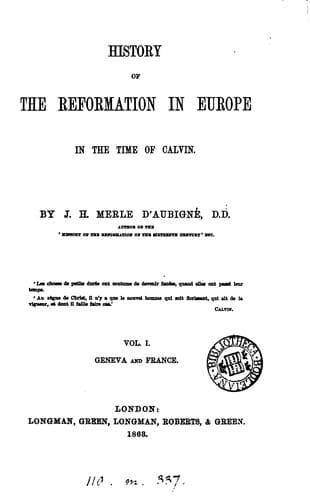
History of the Reformation in Europe in the Time of Calvin, Vol. 6 (of 8)Merle d'Aubigné, J. H. (Jean Henri)
History
History of the Reformation in Europe in the Time of Calvin, Vol. 6 (of 8)
Merle d'Aubigné, J. H. (Jean Henri)
Reformation
If the reformer had been able to preach with tranquillity in the
morning, it was to be otherwise in the evening. The most furious of
his adversaries thought that they owed him something, and in their
wrath meant to discharge the debt. So long as they had had to do
only with the good-natured Farel, matters had gone on pretty well,
notwithstanding his lively sallies; but this young man from Noyon was
a spirit of a different stamp, and since he came to Geneva everything
had changed. He had a methodical intellect and the faculty for
organization. Had he not prepared a fundamental law of the Church, to
which they had been obliged to take the oath at St. Peter’s? He wanted
to regulate everything, and this was not convenient. Since Farel had
been attacked, it was not fair to let Calvin escape. An uproar had
been made in the morning at St. Gervais; another shall be made in the
evening at the church of St. Francis at Rive. It was in that convent
that Farel had for the first time appeared in the pulpit, March 1,
1534; and there Calvin was to preach, April 21, 1538. The quarter in
which this convent stood was situated in the lower part of the town,
not far from the shores of the lake, and it was probably less quiet
than the neighborhood of the cathedral. The church was speedily filled,
and Calvin arrived. He began his sermon. Knowing that Farel had been
treated worse than himself, it is possible that, to leave no ground
for reproaching himself, he might think it his duty to put a stronger
emphasis on his words, and to lay stress on certain things, in order to
make them observed and felt. For the rest, had he spoken like an angel,
he would not have escaped the tumult. Men’s minds were irritated; the
thought of resisting this inflexible man had seized on many, and made
them frantic; they had even taken their swords, and had come to church
as to a military parade. Violence often remains at first smouldering,
silent, and makes no sign. It appears to have been so in this case; but
at some word uttered by the preacher, it revealed itself in a sudden
explosion. One would have said that a stormy wind passed over that
crowd, and impressed on it a passionate movement. In the church of
Rive there were violent speeches and threatening gestures. This was not
all. In sight of that orator, whose dignity and power irritated them,
the most furious drew their swords, and the flash of steel was seen in
the sanctuary of peace. No one, it is true, directed the fatal edge at
the throat of the orator. It appears, however, that a struggle took
place between the friends and the enemies of the Reformation, and that
arms were crossed; for the great magistrate of Geneva in the sixteenth
century, Michel Rozet, felt bound to say in his chronicle that the
affair passed off _without bloodshed_.[638] The syndic Gautier, too,
looks on this fortunate circumstance as _a kind of miracle_. Thus,
after having heard the firing of arquebuses, fifty or sixty times in
Public-domain text, read in full here on John Shaqi.
Reviews
Reviews
No reviews yet
Be the first to share your thoughts on this work.
Elsewhere in the archive
Join the Discussion
Join the discussion
Sign in to leave a comment or review.
Sign InorCreate an account