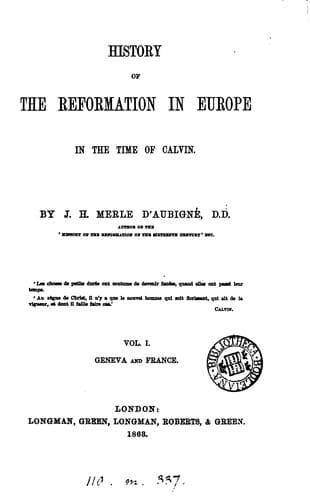
History of the Reformation in Europe in the Time of Calvin, Vol. 6 (of 8)Merle d'Aubigné, J. H. (Jean Henri)
History
History of the Reformation in Europe in the Time of Calvin, Vol. 6 (of 8)
Merle d'Aubigné, J. H. (Jean Henri)
Reformation
More than that, and
Calvin frequently called it to mind, to maintain the necessity of a
life conformed to the Word of God is of importance even to the man
whose conduct is in opposition to his commandments. This necessity is
insisted on not to destroy but to save him. ‘It is maintained in such a
manner,’ said Calvin, ‘as to bring him back into the way of salvation,
and the Church is quite ready to receive him as a friend. She must not
exercise a too rigorous severity; she must not proceed strictly to
extremities and show herself inexorable, but must rather come forward
with gentleness. If this moderation be not carefully adhered to, there
is danger that from correctors we should become executioners.’[636]
These were Calvin’s principles. His discourse has not been handed down
to us, but it is impossible to suppose that he did not speak according
to his deepest convictions; and if he did so, that would partly account
for the calmness with which he was listened to. He was, however,
mistaken on one point, and this we cannot too fully acknowledge. At
that time the Church and the state were everywhere almost confounded,
so that ‘the state did not hesitate to intermeddle in many subjects
which were within the province of the Church.’[637] This was
particularly the case at Geneva. Of all the reformers, Calvin was the
one who had it most at heart to establish the autonomy of the Church,
and thereby a certain independence of the two societies. But, like his
contemporaries, he adhered to the opinions of his own age and of those
which had preceded it. The elements of Judaic discipline had, from the
first century, trenched on the ground of Christian discipline. The
Reformation doubtless effected everywhere a great change in this state
of things; but still the state was seen, even at Geneva, thrusting its
iron arm into the midst of the Christian societies for the purpose of
striking the guilty. That is a coarse and fatal error, one which every
true Christian must energetically cast from him. Fortunately there
could be no question on this point in the great conflict of Easter
1538. The state was then for the moment separated from the Church, and
the reformers did not and would not make use of any other weapons than
those of the Spirit.
[Sidenote: HIS EVENING SERMON.]
Public-domain text, read in full here on John Shaqi.
Reviews
Reviews
No reviews yet
Be the first to share your thoughts on this work.
Elsewhere in the archive
Join the Discussion
Join the discussion
Sign in to leave a comment or review.
Sign InorCreate an account