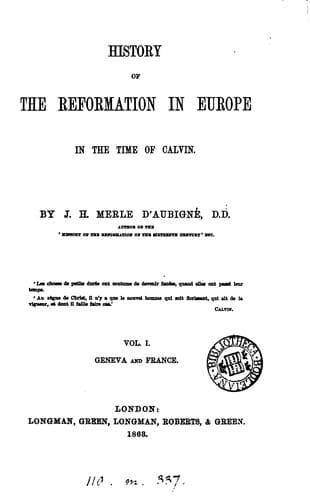
History of the Reformation in Europe in the Time of Calvin, Vol. 6 (of 8)Merle d'Aubigné, J. H. (Jean Henri)
History
History of the Reformation in Europe in the Time of Calvin, Vol. 6 (of 8)
Merle d'Aubigné, J. H. (Jean Henri)
Reformation
On April 22 the syndics set forth the facts before the Two Hundred,
dwelling particularly on the subject of the bread, although the
ministers had stated that that question had nothing to do with their
resolution. The _bread_ seemed, therefore, to be merely used as a
pretext. The syndics inquired of the Two Hundred whether they wished
to adopt the ritual used at Berne. They replied in the affirmative.
We have seen that the dominant party had obtained a majority in this
council, and by what means they did so. The syndics next complained
that the ministers had preached on Easter Day, although the magistrate
had forbidden it, and they inquired whether they ought not to be
committed to prison. The Two Hundred would not hear of imprisonment;
but, with no less severity, they resolved to interdict the three
ministers, Calvin, Farel, and Courault, from occupying the pulpit in
the churches of the republic, and to order them to leave the city
immediately upon the appointment of their successors. It is remarkable
that, according to the Registers of the council, no mention was made
either of the charges of licentiousness and blasphemy which Farel
and Calvin had made in the pulpit, or of the refusal to celebrate
the supper which had been the consequence. It is easy, however, to
understand this silence. Those charges, were, undoubtedly, the most
important fact in the conflict, and the magistrates, in omitting
them, were straining at the gnat and swallowing the camel. Calvin
said subsequently, but not with reference to this special instance,
‘Hypocrites, while they do not hesitate to give themselves up to
indulgence in the grossest vices, are all the more austere and rigorous
in matters which are of comparatively slight importance; and while
they make pretence in that way of humbling themselves before God, they
proudly insult him to his face.’[639] Licentiousness and blasphemy were
very unpleasant topics, and on them the council was not at all inclined
to dwell. Besides, had these grievances been spoken of, there must have
been an investigation, evidence must have been taken, and witnesses
called; and all this would have been very troublesome, and have taken a
long time. Even if the government had commenced proceedings against the
pastors, to punish them for making those charges, it is very doubtful
whether they would have gained their cause, at least in the judgment
of impartial men. It was a far more simple and expeditious plan to
insist on this single fact, that preaching had been prohibited to the
ministers, and that nevertheless they had preached. This required no
proof, for all the town had seen and heard them. It is quite evident
that it was on this ground they were punished. The council stood on its
right, but it was assuredly a case to which the saying applies, _Summum
jus summa injuria_.[640]
[Sidenote: DENIAL OF JUSTICE.]
Public-domain text, read in full here on John Shaqi.
Reviews
Reviews
No reviews yet
Be the first to share your thoughts on this work.
Elsewhere in the archive
Join the Discussion
Join the discussion
Sign in to leave a comment or review.
Sign InorCreate an account