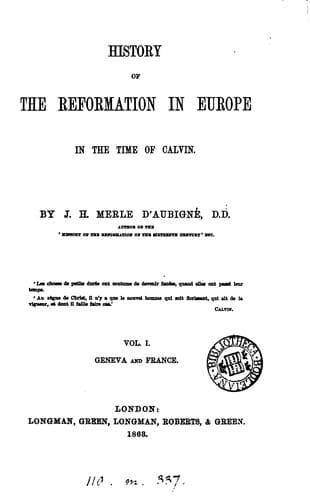
History of the Reformation in Europe in the Time of Calvin, Vol. 6 (of 8)Merle d'Aubigné, J. H. (Jean Henri)
History
History of the Reformation in Europe in the Time of Calvin, Vol. 6 (of 8)
Merle d'Aubigné, J. H. (Jean Henri)
Reformation
After these disorders, these stormy scenes, and the banishment of the
reformers, what was likely to happen? The bond of religion, so powerful
to keep in check criminal desires and actions, being once broken,
would not confusion, already so great, overrun the unhappy city? Would
not the evangelical faith be trampled under foot? Should we not find
Protestants themselves willing to join the mass with the Gospel?
Would not Rome conspire to reintroduce in Geneva ‘the old religion’?
Would not political independence itself be endangered? Would not the
enemies of the Reformation attempt to make some compact with Savoy,
and would not Berne itself, to whose influence Calvin seemed to be
sacrificed, imperil the Genevese liberties? These fears, alas, were
only too well founded! Calvin, who had so rigorously resisted Farel
when the latter pressed him to settle at Geneva, could not now make up
his mind to abandon the place. He wished to remain there to contend
with all his might against the dangers which he saw besetting the
city. ‘We perceived very clearly,’ he said, ‘that in this extremity,
the safety of the Church required that she should not be deprived of
her leaders. We therefore labored to retain our ministry as if it
had been a struggle for our own existence.’[641] Calvin was anxious
at all cost to prevent any overturn or convulsion in the Church and
in the State. He felt the necessity of enlightening the people, of
making them understand the importance of moral conduct, Christian
faith, and cordial union. ‘It appeared to him,’ said he, ‘far easier
to uphold the Church at the moment when she was ready to fall, than
to re-establish her when once she had fallen, and was as good as
lost.’[642] He therefore claimed, and claimed instantly, to be allowed
to give an account of his reasons to the general council. He would
explain everything, and the right side would win. It is unjust to deny
a man accused the opportunity of setting forth the reasons of his
conduct. But all was fruitless. Were the syndics afraid that Calvin
would convince the people, or that the people would insult Calvin? We
cannot decide the point. However it might be, they refused him what
was due to him. It was a denial of justice. They preferred to condemn
him without a hearing. Neither his own representations nor those of his
colleagues were of any avail. Party spirit went so far as to close the
mouth of the most eloquent, the most profound, the most learned, the
most sincere, and the most able man of the age.[643]
The next day, April 23, the general council met in the cloisters of St.
Peter’s to decide the fate of the reformers without having heard them.
Le pire des états, c’est l’état populaire,--
Public-domain text, read in full here on John Shaqi.
Reviews
Reviews
No reviews yet
Be the first to share your thoughts on this work.
Elsewhere in the archive
Join the Discussion
Join the discussion
Sign in to leave a comment or review.
Sign InorCreate an account