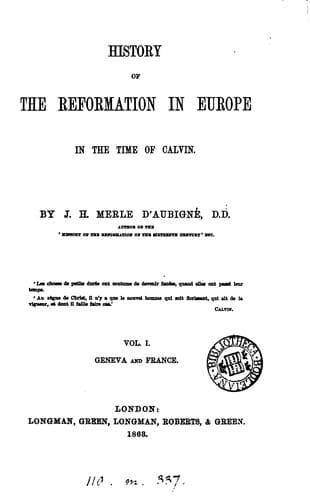
History of the Reformation in Europe in the Time of Calvin, Vol. 6 (of 8)Merle d'Aubigné, J. H. (Jean Henri)
History
History of the Reformation in Europe in the Time of Calvin, Vol. 6 (of 8)
Merle d'Aubigné, J. H. (Jean Henri)
Reformation
said great men of the seventeenth century.[644] We think
otherwise in the nineteenth. It is nevertheless true that the people
frequently disappoint the expectation formed of them, and deceive
themselves. Every age has presented terrible examples of this. The
people allow themselves to be easily influenced, and they rush headlong
in the footsteps of those whom they have chosen for guides. This was
what took place at Geneva. The syndics inquired of the people whether
they wished to make use of unleavened bread at the supper, as was done
at Berne, ‘without further dispute.’ The majority was in favor of
unleavened bread, although they probably did not very clearly know what
it meant. The syndics then informed the general council ‘that Farel,
Calvin, and their colleagues had refused to obey the command of the
magistrate; and inquired whether they would dismiss them or not.’ The
‘greatest voice,’ that of the majority of the people, in accordance
with the resolution of the Little and the Great Councils, determined
that they must leave the city within the next three days. ‘Thus was
it ordered, the greater number in the council overcoming the better
part.’[645] Such a course adopted against the most eminent men at that
time in Geneva, the only ones whose names have come down to posterity,
and carried out without giving them a hearing, was one of those violent
measures to which bad governments sometimes have recourse--a _coup
d’état_.
[Sidenote: ORDER OF EXPULSION.]
Further, this same council deposed the secretary who had read the
articles of reformation. This secretary was Claude Rozet, who had
received the oath to the confession of faith on the famous day of July
29, 1537. While banishing the three ministers, they wished to inflict
a blow on at least one layman, and they made choice of the man who,
in his official capacity, had established in Geneva the _articles of
reformation_.[646]
Orders were given to make known to the reformers without delay the
decree of the people, and the head usher was appointed, without further
ceremony, to discharge that office. This man, having reached Calvin’s
house, told him that he was enjoined by decree of the general council
‘to preach no more in the town, and to take his departure within the
next three days.’[647] The reformer calmly made answer, ‘If we had
served men, we should certainly be ill repaid; but happily for us we
serve a greater master, who pays servants even what he does not owe
them.’[648] The usher went next to Farel’s house. His reply to the
announcement was, ‘Well and good; it is well, it is from God.’ In
these words of the reformers there is a peace, firmness, and grandeur
of soul which immediately strike those who read them, which some
historians have called heroic,[649] and which no one has a right to
call feigned.[650] Meanwhile the council was busied with other matters.
Public-domain text, read in full here on John Shaqi.
Reviews
Reviews
No reviews yet
Be the first to share your thoughts on this work.
Elsewhere in the archive
Join the Discussion
Join the discussion
Sign in to leave a comment or review.
Sign InorCreate an account