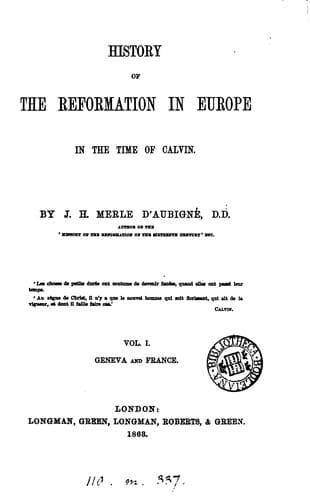
History of the Reformation in Europe in the Time of Calvin, Vol. 6 (of 8)Merle d'Aubigné, J. H. (Jean Henri)
History
History of the Reformation in Europe in the Time of Calvin, Vol. 6 (of 8)
Merle d'Aubigné, J. H. (Jean Henri)
Reformation
GREAT CONFUSION IN GENEVA.--THE COUNCIL OF BERNE MAKES A FRUITLESS
INTERVENTION.
(END OF APRIL, 1538.)
Meanwhile, the friends of the Gospel in Geneva had received a very
severe blow, which had fallen on them in an unexpected way. Many were
plunged into excessive grief; some lost all hope of ever seeing the
Gospel honored in that turbulent city. Some mourned silently, others
spoke their grief aloud. The most pious of them undoubtedly expected
from the faithfulness of God that restoration of faith, order, and
prosperity for which they longed so ardently. But ‘all good men,’ says
Beza, ‘saw with great pain their three pastors, in obedience to the
edict of banishment,’[661] depart from that town to which they had
desired to do so much good; and with regretful eyes, or with tender
thoughts, they followed them as if they could not part with them.
[Sidenote: GREAT CONFUSION IN GENEVA.]
The vulgar and mischievous demonstrations by which the most lawless
part of the population celebrated its triumph still further aggravated
the grief of serious men. The discomfiture of the pastors was laughed
at and turned into ridicule. Professional jesters have almost all a
false and superficial wit, and in every country it rains insects of
this kind.[662] They were not wanting at Geneva. We do not know whether
they went on the stage, but they played in masquerades. Large bodies of
these jesters were seen parading the streets, laughing, brawling, and
making disturbances. One of them, and he was the principal personage,
was holding a fryingpan by its long handle; and in the fryingpan were
lamp-wicks, which were called in the patois of the country _farets_.
Those who surrounded this standard-bearer exclaimed that they had
fricasseed _Farel_ (and his colleagues with him) like chickens or
turnips which are cut in pieces and then cooked in a stewpan. These
poor wretches were at bottom right: the ministers had in fact been
burned over a slow fire. _Bons mots_ and sarcasms gave a relish to this
strange dish; and there were persons in those days who would have been
glad to see the ministers who left Geneva ‘fall out of the fryingpan
into the fire’--from one state of vexation into another still worse.
Insults and derision were showered from all quarters. ‘Processions
of this sort usually end in debauchery. The citizens took license,’
says Rozet, ‘for impurity, dancing, games, and drunkenness.’ ‘Nothing
was talked of but masquerades, gallantries, and excesses in wine and
good cheer.’[663] Thus did the mass of the population celebrate the
departure of the pastors. ‘The wicked travaileth with iniquity, and
hath conceived mischief, and brought forth falsehood.’
Public-domain text, read in full here on John Shaqi.
Reviews
Reviews
No reviews yet
Be the first to share your thoughts on this work.
Elsewhere in the archive
Join the Discussion
Join the discussion
Sign in to leave a comment or review.
Sign InorCreate an account