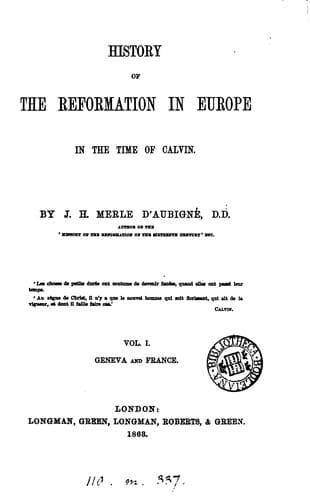
History of the Reformation in Europe in the Time of Calvin, Vol. 6 (of 8)Merle d'Aubigné, J. H. (Jean Henri)
History
History of the Reformation in Europe in the Time of Calvin, Vol. 6 (of 8)
Merle d'Aubigné, J. H. (Jean Henri)
Reformation
As for the members of the councils, they let things take their course.
If they did issue any proclamation for the purpose of repressing these
disorders, little attention was paid to it. Besides, they did not
insist on its being obeyed. They attempted, however, to establish a
Church of some kind. The minister, Henri de la Mare, had not dared,
in spite of the order which he had received, to preach and administer
the supper on Easter Day, for fear of offending Farel and Calvin.
But, like the former superior of the Franciscans Jacques Bernard,
he had abstained from joining in their protest. These two men were
intrusted by the council with the functions of the three banished
ministers. At the same time the lords of Berne were requested to send
the ministers Marcourt and Morand, who did not come till afterwards.
The magistrates also ordered the restoration of the baptismal fonts
which had been taken down, and which were thenceforth to be used at
the baptism of children. Then they had proclamation made, with sound
of trumpet, that everyone would have to conform to what had been
decreed touching the supper, baptism, festivals, etc. But De la Mare
and Bernard were not men powerful enough to fill the place of Farel
and Calvin. They were far from enjoying high consideration, and were
frequently exposed to the criticism and even to the rebukes of their
hearers. Porral especially made loud complaint of their preaching. The
council took their part; and one Groli having accused Bernard of not
preaching according to the Word of God, the critic was condemned ‘to
beg for mercy at the hands of God and of the law, _with both knees on
the ground_.’ Had this happened in the time of Calvin, it would have
been a very godsend for those who delight in slandering that great
man; but the punishment was inflicted by his adversaries on one of
his partisans. The question, however, remains ever the same; and this
act of compulsion in the sphere of religious opinion was even more
censurable because it was the act of the very men who had driven away
the reformers for having attempted to infringe on their liberty. There
were, however, some cases more quietly settled. An influential citizen,
the former syndic Porral, having also criticised the preachers, the
council did nothing more than threaten him with its _indignation_; he
had not _to go down on his knees and beg for mercy_.
[Sidenote: THE REFORMERS AT BERNE.]
Public-domain text, read in full here on John Shaqi.
Reviews
Reviews
No reviews yet
Be the first to share your thoughts on this work.
Elsewhere in the archive
Join the Discussion
Join the discussion
Sign in to leave a comment or review.
Sign InorCreate an account