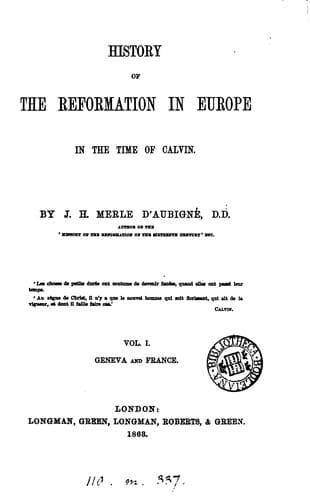
History of the Reformation in Europe in the Time of Calvin, Vol. 6 (of 8)Merle d'Aubigné, J. H. (Jean Henri)
History
History of the Reformation in Europe in the Time of Calvin, Vol. 6 (of 8)
Merle d'Aubigné, J. H. (Jean Henri)
Reformation
On receiving this letter the council of Geneva was still more excited
than that of Berne had been. The angry feelings which actuated its
members and which had led them to banish the reformers were not yet
soothed; and, as it has been remarked, their reply was of such a nature
as was to be expected from men dominated by passion.[668] They wrote
to Berne that they considered ‘very strange’ the complaints which were
sent to them; that they ‘could not imagine how Farel and Calvin were
so bold as to make untrue statements to their Excellencies; that there
was no great discord in their town, for on the previous Sunday the
supper had been observed, according to their own ceremonial, by a great
number of people, all of one mind.’ Which amounted to this--that the
pastors having been driven away without a hearing, their hearers being
intimidated, and the party opposed to the Gospel triumphant, uniformity
prevailed by means of violence and of fear. This is, indeed, the usual
result of a _coup d’état_.
CHAPTER XIII.
SYNOD OF ZURICH.--THE BERNESE AMBASSADORS CONDUCT CALVIN BACK
TO GENEVA.--HE CANNOT ENTER THE TOWN.
(END OF APRIL TO END OF MAY, 1538.)
[Sidenote: FAREL AND CALVIN AT ZURICH.]
Farel and Calvin did not allow themselves to hesitate by reason of the
obduracy of their enemies. They were determined to do all they could
to save the Church and likewise the town of Geneva from the calamities
which, in the opinion of good men in Switzerland, must certainly fall
upon them. The synod of the reformed Churches of this country, to the
decision of which they had appealed, was now sitting at Zurich. They
went thither without delay, to inform the assembly of the important
events which had taken place at Geneva, and to claim its mediation. The
deputies of Basel, Berne, Schaffhausen, St. Gall, Glaris, Mulhausen,
and Bienne, in conjunction with the doctors of Zurich, constituted the
assembly, which sat from April 29 to May 3. Bucer and Capito had also
come from Strasburg to be present at it. The principal business of the
synod was the union with Luther, who at that time showed a conciliatory
disposition. All the members, except Kunz, the Bernese deputy, received
the two exiles with true Christian cordiality. It appears that Farel
and Calvin found relief and relaxation in this meeting of brethren.
From their life at Geneva, constantly in the presence of violent
adversaries, they had probably experienced a kind of moral tension. But
the loyal affection of the Swiss allowed their minds to unbend, and
their souls expanded in the sunshine of charity. After being engaged
on matters relating to the _Concordia_ of Wittenberg, the synod passed
on to the subject of rites, and decided that with respect to them the
Churches ought to retain full liberty--a resolution favorable to Calvin
and Farel. After settling this point, the synod took into consideration
the state of Geneva.
Public-domain text, read in full here on John Shaqi.
Reviews
Reviews
No reviews yet
Be the first to share your thoughts on this work.
Elsewhere in the archive
Join the Discussion
Join the discussion
Sign in to leave a comment or review.
Sign InorCreate an account