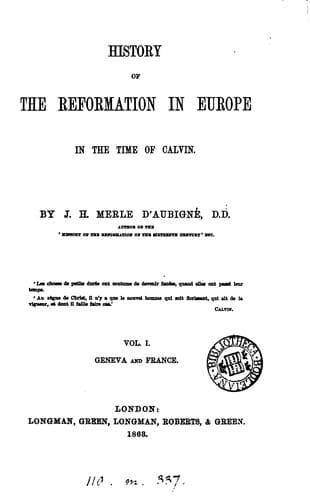
History of the Reformation in Europe in the Time of Calvin, Vol. 6 (of 8)Merle d'Aubigné, J. H. (Jean Henri)
History
History of the Reformation in Europe in the Time of Calvin, Vol. 6 (of 8)
Merle d'Aubigné, J. H. (Jean Henri)
Reformation
None felt these reproaches more keenly than the pastors, for they
knew that they all recoiled on themselves. On September 17 they all
appeared, the two Genevese and the two foreigners, before the council.
‘Calumniators,’ they said, ‘are spreading reports in the cantons
which are doing serious injury to the Gospel.’ They requested that
two of their number might have leave of absence to go and refute the
slanders, which inflicted a blow on the honor of the town. The request
was granted. Marcourt and Morand set out for Berne, and presented
themselves before the assembly of the pastors, in which Kunz could not
fail to support them. In fact it was resolved at this meeting ‘that
those who rose against the persons in office at Geneva were worse than
wicked men, traitors, and Jews.’ The Bernese pastors communicated
this declaration to the council, which contented itself with deciding
that if any defamers of Geneva appeared at Berne, information should
be given to the magistrates of that town. The lay authorities were
obviously less under the influence of passion than the ecclesiastics.
It appears even that the council of Berne did not place implicit
confidence in the report of the Genevese ministers, for one of their
own number was immediately after sent to Geneva to see with his own
eyes what was the real state of the Genevese Church.
The complaints made both at Geneva and in other places were well
grounded. This is proved by the proceedings of the magistrates, who,
although they were hostile to the reformers, perceived that their
own honor required them not to authorize licentiousness. It is quite
certain that people ‘went about the streets at night, uttering cries
and singing indecent songs;’ that ‘gaming, lewdness, haunting of
taverns, and drunkenness,’ were common offences; for a decree of July
19 prohibited them under a penalty of sixty sous for the first time;
and, as the evil continued, other decisions of a similar character
were taken on August 20 and October 22. It is certain that, as was
said in Switzerland, some citizens went to mass, for according to the
intolerant customs of the age, they were ordered ‘to leave the town.’
The councils were seen to be as much opposed to religious liberty as
Calvin had been. Perhaps they went even further than he would have
gone; for, on August 20, they ordered the priests who were still on
Genevese soil to go to sermon if they wished to remain there.
[Sidenote: CALVIN’S LETTER TO THE GENEVESE.]
Public-domain text, read in full here on John Shaqi.
Reviews
Reviews
No reviews yet
Be the first to share your thoughts on this work.
Elsewhere in the archive
Join the Discussion
Join the discussion
Sign in to leave a comment or review.
Sign InorCreate an account