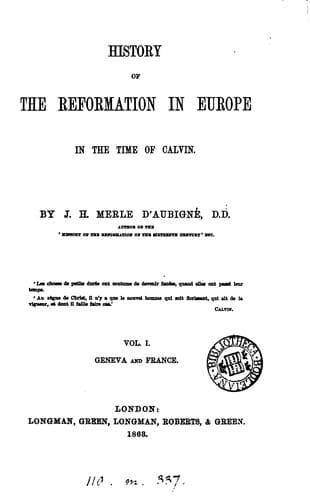
History of the Reformation in Europe in the Time of Calvin, Vol. 6 (of 8)Merle d'Aubigné, J. H. (Jean Henri)
History
History of the Reformation in Europe in the Time of Calvin, Vol. 6 (of 8)
Merle d'Aubigné, J. H. (Jean Henri)
Reformation
Calvin, at Strasburg, was watching attentively what was passing at
Geneva. He heard that a certain number of Genevese kept faithfully
to the path which they had taken under his direction. Some of his
adherents cried out rather loudly, but the majority led a quiet life,
and the most decided of the latter displayed their opposition in no
other way than by absenting themselves from a form of worship which
they did not consider to be in conformity with the principles of
the Gospel. Calvin had not written to them during the first months
of his exile. He was not willing to lay himself open to the charge
of attempting to draw them over to himself. But he felt keenly that
the trials of his friends at Geneva proceeded from their supineness
in adhering to the Word of God, and that the remedy for them was in
humbling themselves before God and waiting upon Him for the remedy.
‘However the affection which he always cherished for them’ did not
permit him to remain longer silent, and on October 1 he wrote to
them a letter remarkable for the pacific, discreet, charitable, and
elevated spirit which it breathed. He addressed it, not to all the
Genevese, but to those who had received into their hearts the seed of
the divine Word, and who were still deeply affected by the blow which
had struck them in the punishment of their pastor. He named them his
brethren, _the relics of the dispersion of the Genevese church_. He
spoke of the love which he bore them. ‘I cannot refrain from writing to
you,’ said he, ‘to assure you of the affection which I always cherish
for you. Our conscience is fully persuaded before God that it is by
his call that we were at one time associated with you, and it ought
not to be in the power of men to break such a bond.’ He begs them to
forget themselves and their sufferings, to forget even the hostility
of their adversaries. ‘If we lose our time in fighting against men,’
he said, ‘thinking only of taking vengeance and getting indemnified
for the injuries which they have done us, it is doubtful whether we
can overcome them, but it is certain that we shall be overcome by the
devil. If on the contrary we resist the devices of that spiritual
enemy, there is no fear then of our not coming off conquerors. Cast
away every evil affection, be led only by zeal for God, controlled
by his Spirit and the rule of his Word.’ Calvin went further. He
showed himself severe to his friends. ‘It is easy for you to justify
yourselves before men, but your conscience will feel burdened before
God.’ He did himself what he required of others. ‘I doubt not,’ he
said, ‘that God has humbled us in order to make us acquainted with our
ignorance, our imprudence, and our other infirmities, of which I for
my part have been fully conscious, and which I have no hesitation in
confessing before the Church. However,’ he adds, ‘we did faithfully
administer our office. The Lord will cause our innocence to come forth
Public-domain text, read in full here on John Shaqi.
Reviews
Reviews
No reviews yet
Be the first to share your thoughts on this work.
Elsewhere in the archive
Join the Discussion
Join the discussion
Sign in to leave a comment or review.
Sign InorCreate an account