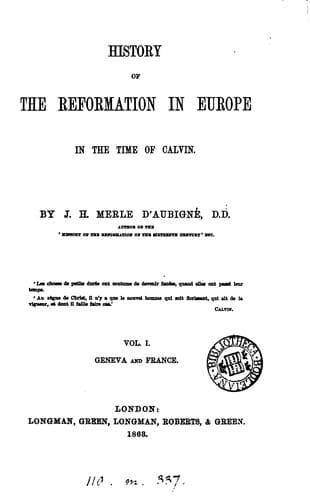
History of the Reformation in Europe in the Time of Calvin, Vol. 6 (of 8)Merle d'Aubigné, J. H. (Jean Henri)
History
History of the Reformation in Europe in the Time of Calvin, Vol. 6 (of 8)
Merle d'Aubigné, J. H. (Jean Henri)
Reformation
like the morning-star, and our righteousness to shine like the sun.’
But he endeavors chiefly to console the believers of Geneva. ‘Be not
cast down because it hath pleased the Lord to humble you for a time,
for he lifts up the humble out of the dust and takes the poor from
the dunghill. He gives the manna of joy to those who are in tears; he
gives back light to them that sit in darkness, and he restores to life
them that walk in the shadow of death. Be of good courage then, and
endure with patience the chastening of his hand, until the time that
he reveal his grace to you.’[744] It is impossible not to recognize
the wisdom and the Christian charity which have left their impress on
this letter. It is indeed a pastor that speaks. Calvin was so far from
the excessive strictness imputed to him that he wrote at the same time
to Farel--‘If we find in any Church the ministry of the Word and the
sacraments, it is better not to separate from it. It is not right even
to do so on the ground that some doctrines are not purely taught in it;
for there is hardly a Church in existence which does not retain some
traces of its former ignorance. It is sufficient for us if the doctrine
on which the Church is founded has its place there and keeps it.’[745]
Calvin held that there are some doctrines fundamental and vital,
essential to salvation; but he acknowledged that there are others on
which difference is permissible.
[Sidenote: FAREL’S LETTER TO THE GENEVESE.]
Farel likewise wrote to the Christians of Geneva. He did so even before
Calvin, in June, in August, and again in November. He expressed to
them his deep sadness. He would fain be ‘so far away that he could
hear nothing of the miserable breaking-up and dispersion of the
Church.’ He strives ‘to banish from his heart the pains, the labors
that he undertook for that town; for nothing pierces the heart like
ingratitude; to see evil rendered for good, hate for love, death and
shame in place of the life and the honor which were procured.’ He
contents himself with praying for the town and commending it to all who
are able to give it any assistance. Meanwhile he cannot help seeing
the unhappy condition in which his own friends and all the faithful of
Geneva are, deprived of their pastors, and witnessing the triumph of
their enemies. He shares largely in their troubles; they are his only
trial. ‘I should be too happy,’ he wrote to them, ‘if you were not so
unhappy.’ But at the same time he exhorts them to Christian charity
and gives evidence of it himself. ‘Cherish in your hearts no rancor,’
he said to his former flock, ‘no root of bitterness, no anger. Do not
reproach this man nor that man, but let each one reproach himself: lay
all the blame on yourselves and say nothing but good of others. Let
God’s holy will be your rule, and not _poor man_ (the natural man),
and what is in him.’ He does not hesitate to rebuke his friends. ‘You
have not obeyed God wholly, but have halted and swerved to one side and
Public-domain text, read in full here on John Shaqi.
Reviews
Reviews
No reviews yet
Be the first to share your thoughts on this work.
Elsewhere in the archive
Join the Discussion
Join the discussion
Sign in to leave a comment or review.
Sign InorCreate an account