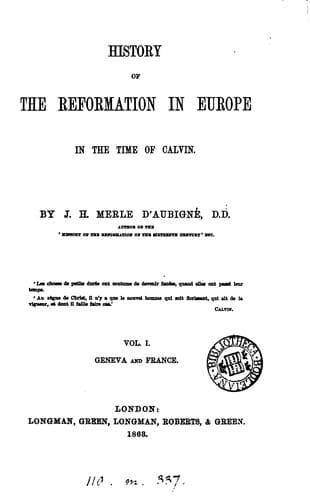
History of the Reformation in Europe in the Time of Calvin, Vol. 6 (of 8)Merle d'Aubigné, J. H. (Jean Henri)
History
History of the Reformation in Europe in the Time of Calvin, Vol. 6 (of 8)
Merle d'Aubigné, J. H. (Jean Henri)
Reformation
Another happiness awaited Calvin at Strasburg. His greatest sufferings
at Geneva had their source in that state-church, that people-church,
that shapeless community which comprised the whole nation, believers
and unbelievers, righteous men and profligates. In its place at
Strasburg he found some Christians exiled on account of their faith,
purified by their trial like gold, who had given up all for Christ,
their righteousness and their life. The mass of professing Christians
at Geneva had as it were suffocated him. Now at Strasburg he was in the
midst of brethren and sisters, and almost all of them belonged to his
own country, France. He breathed freely. The evangelical order intended
by the apostles prevailed in his Church.[750] He preached four times a
week. He met his elders and deacons once a week for the study of the
Holy Scriptures and for prayer; and some of those lay friends well
endowed by God were soon qualified to take the place of their pastor in
case of his absence, and to edify their brethren. The first supper was
celebrated in September, and it was repeated every month. How wide the
difference for Calvin between that repast at Geneva, to which men came
who drank, gamed, quarrelled, and sang indecent songs, and whom, for
all that, he had to admit to the communion of the body and the blood
of the Redeemer, and this brotherly supper at Strasburg, celebrated
in company with pious Christians, persecuted for righteousness’ sake,
whose names were written in heaven, and who drew nigh to the Lord with
devotion, as members of his family! Calvin gave all his attention to
the cure of souls. If there were any Christians who had not an adequate
acquaintance with the doctrine of salvation, he instructed them; if any
were reproached by their own conscience, cast down and in distress, he
consoled and lifted them up; if any had gone astray from the path of
righteousness, he rebuked them. He certainly met with some opposition,
especially on the part of the younger folk; but he held his ground.
While he required a pure faith and life, he protested against the
tyranny exercised by the priests in auricular confession, and declared
that no man had the right to bind the conscience of his brethren. Thus
he saw his flock thriving from day to day under his direction.[751]
‘It was at Strasburg that the first Church was organized to serve as a
model to others,’ says Raemond. A remarkable conversion distinguished
its early days. Herman of Liége, who had engaged in discussion with
Calvin at Geneva, was converted by him and joined his Church. He
embraced the doctrines which Calvin found in the Holy Scriptures, on
free will, the divinity and humanity of Christ, regeneration, and
baptism. He was in doubt only as to predestination. Calvin gained other
victories besides.
[Sidenote: VIEW OF THE LORD’S SUPPER.]
Public-domain text, read in full here on John Shaqi.
Reviews
Reviews
No reviews yet
Be the first to share your thoughts on this work.
Elsewhere in the archive
Join the Discussion
Join the discussion
Sign in to leave a comment or review.
Sign InorCreate an account