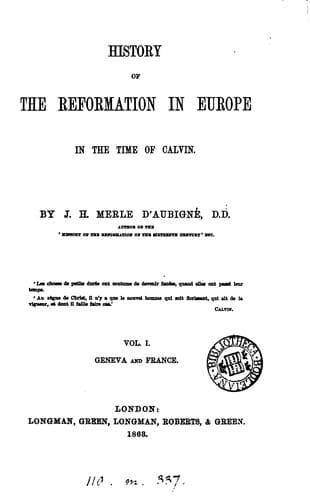
History of the Reformation in Europe in the Time of Calvin, Vol. 6 (of 8)Merle d'Aubigné, J. H. (Jean Henri)
History
History of the Reformation in Europe in the Time of Calvin, Vol. 6 (of 8)
Merle d'Aubigné, J. H. (Jean Henri)
Reformation
He was now not only a pastor, but also a teacher. At the beginning
of the year 1539, Capito, struck with his gifts for theological
teaching, entreated him to join that office with his pastorate.
Although he felt reluctant to do so, from his sense of the difficulty
of that ministry, he at length consented. Every day he preached in
the church of St. Nicholas, in which he taught the students of the
academy. The interpretation of the Scriptures was for him the basis
of theological science, and for his exposition he selected two of
the richest books of the New Testament--the Gospel of St. John and
the Epistle to the Romans. His plan was to search out the meaning of
the sacred writer, and to set it forth with an easy ‘brevity which
did not entail obscurity;’ and for that purpose ‘he took pains to
regulate and proportion his style.[752]’ In his view the Epistle to
the Romans was ‘a path to the understanding of the whole Scripture.’
Some doctors attended these lectures, and expressed their high
admiration.[753] He did not content himself with being at the same
time pastor and professor, he also worked diligently in his study. He
revised his _Institution_, and prepared a second edition; he recast
his _Catechism_; he composed a treatise on the Supper, of which he
sent a copy to Luther. Calvin, like Zwingli, regarded the bread and
the wine as signs, as pledges that Christ gives to the believer his
crucified body and his shed blood; that is to say, communicates to him
the expiatory virtue of his death. He taught that the believer receives
the body and the blood by faith, which is _the mouth of the soul_, and
not by the bodily mouth. But he differed from the reformer of Zurich in
that he saw in the supper a mysterious union with the glorified person
of Christ. ‘With good reason,’ he said, ‘the bread is called body,
since it not only _represents_ him, but also _presents_ him to us. We
must therefore really receive in the supper the body and the blood of
Jesus Christ, since the Lord sets forth to us therein the communion of
both. If God gave us only bread and wine, leaving behind the spiritual
truth, would it not be the case that he had instituted this mystery
on fictitious grounds?[754] This alliance is effected on our part by
faith, and on the part of God by his secret and miraculous virtue. The
Spirit of God is the bond of this participation; that is why it is
called spiritual. When Luther began his course, he appeared to say that
the bread was the body of Christ. Œcolampadius and Zwingli appeared to
leave in the supper nothing but the bare signs without their spiritual
substance. Thus Luther failed on his side, Zwingli and Œcolampadius on
their side. Nevertheless, let us not forget the grace which the Lord
gave to all of them, and the benefits which he has conferred on us by
their instrumentality.’[755]
Public-domain text, read in full here on John Shaqi.
Reviews
Reviews
No reviews yet
Be the first to share your thoughts on this work.
Elsewhere in the archive
Join the Discussion
Join the discussion
Sign in to leave a comment or review.
Sign InorCreate an account