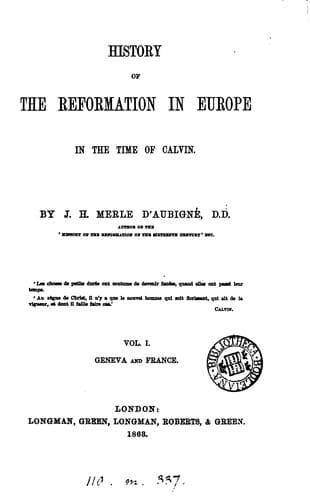
History of the Reformation in Europe in the Time of Calvin, Vol. 6 (of 8)Merle d'Aubigné, J. H. (Jean Henri)
History
History of the Reformation in Europe in the Time of Calvin, Vol. 6 (of 8)
Merle d'Aubigné, J. H. (Jean Henri)
Reformation
Just at the time when Calvin was gaining new friends at Strasburg, he
lost some of his oldest and most beloved ones. We have seen his grief
on hearing of the death of Courault. At the beginning of January 1539,
he received a letter from Francesca Bucyronia, wife of the physician
Sinapi, tutor to the children of the Duchess of Ferrara, informing
him that his cousin Olivétan, one of the first evangelists of Geneva,
and translator of the French version of the Bible, had just died in
that town. Calvin’s pain at this news was increased by the report
that his friend, while at Rome, had taken poison, and that of this
he died. This was a conjecture at that period commonly put forward
to account for unexpected deaths. There is little probability of its
truth. Calvin does not speak of it. He contents himself with calling
Olivétan _our friend_, and adds that the natural sorrow which he feels
must be his apology to his correspondents for his short and disjointed
letters.[760] Few men have had so many friends as Calvin. His was no
ordinary friendship; it was always felt to be deep and unchangeable.
But Calvin’s thought was at this time occupied with affection of
another kind. He believed that those who have received a new life from
Christ are called to love all those who have received the same grace;
‘to love them with that simple affection, that natural proneness,
with which relations love each other.’ It was, however, no exclusive
love that he required. ‘In bidding us begin by loving the faithful,
the Lord leads us on, by a kind of apprenticeship, to the loving of
all men without exception.’[761] But union and agreement between the
children of God was the great need of his heart. When writing to
Bullinger (March 12, 1539) he said--‘Satan, who plots the ruin of the
kingdom of Christ, sows discord between us. Let us all then have a
cordial agreement with one another, and may it be the same with all the
Churches. I clasp you in my arms, wishing you all good.’[762]
With this cordial charity Calvin maintained an indomitable courage.
Capito was given to looking at the dark sides of things: black thoughts
often hovered around him and took possession of his imagination. In
vain his faith strove to lighten the darkness; mournful forebodings
overwhelmed him, and a dull distress was often read in his countenance.
One day he protested before God and men that the Church was lost unless
prompt aid should arrive. Afterwards, when he found that the state of
things did not improve, he prayed God that he might die.[763] It was
not so with Calvin. ‘Ah,’ said he, ‘the Lord will bless us although
everything should be against us. Let us therefore try all remedies; and
if we do not find any to be efficacious, let us nevertheless persevere
as long as we have any breath of life.’[764] It is this unconquerable
steadfastness which made Calvin the great reformer.
[Sidenote: DESPOTISM AT GENEVA.]
Public-domain text, read in full here on John Shaqi.
Reviews
Reviews
No reviews yet
Be the first to share your thoughts on this work.
Elsewhere in the archive
Join the Discussion
Join the discussion
Sign in to leave a comment or review.
Sign InorCreate an account