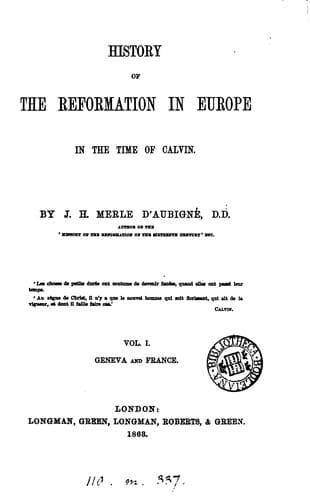
History of the Reformation in Europe in the Time of Calvin, Vol. 6 (of 8)Merle d'Aubigné, J. H. (Jean Henri)
History
History of the Reformation in Europe in the Time of Calvin, Vol. 6 (of 8)
Merle d'Aubigné, J. H. (Jean Henri)
Reformation
The faith of Calvin was not to deceive him. But few voices had been
raised in his favor at Geneva in the general council of May 26, 1538.
The minority which adhered to the Reformation had at first shrunk
away into retirement and silence. The most active men, who are not
always the wisest, alone had spoken. But gradually the more competent
influential men appeared, recognized and united with each other, and
took combined action. The government party made little account of them;
and as Master Guillaume, as they called Farel, was in the popular
judgment the chief of the Evangelicals, they used to call these, with
a shrug of the shoulders, the _Guillemins_, nor had they a suspicion
that these people would ever recover themselves. The council, which was
little disposed to respect individual freedom, less so perhaps than
Calvin and Farel, ordered all heads of families to attend sermon on the
Sunday. This order was especially aimed at the friends of the reformers
and their refusal to hear the ministers who had taken the place of the
latter, and who, to make themselves agreeable to the magistrate, openly
censured their predecessors.
Farel and Calvin had established in Geneva not only the Church but
also the school; and some of their best friends, Saunier and Mathurin
Cordier were among the most eminent masters. This institution naturally
remained faithful to its founders, and the conduct of the government
towards it showed that they looked on it as decidedly opposed to
their views and opinions. The council did not intend to allow its
subordinates to show themselves hostile to its scheme for the direction
of ecclesiastical affairs. However, while they shrank perhaps from
disorganizing the school, they resolved, sparing at the outset the
leading men, to give them a lesson by energetically prosecuting one or
two of their under-masters.
Eynard and Gaspard were consequently cited, September 10, before
the council, which made complaint of their publicly censuring the
_preachers_, and inquired of them where they had received the supper
at Easter and Whitsuntide. They replied that they had not joined in
the communion anywhere, because St. Paul enjoined _that every man
should examine himself_, and that they had not felt in the right frame
of mind. They had no doubt been unwilling to receive the bread and
the wine, which are the communion of the body and the blood of the
Saviour, from the hands of pastors whom they judged unworthy. The
council ordered them to leave the town in three days. After having thus
inflicted disciplinary penalties on the humble under-masters, they
awaited Christmas.
Public-domain text, read in full here on John Shaqi.
Reviews
Reviews
No reviews yet
Be the first to share your thoughts on this work.
Elsewhere in the archive
Join the Discussion
Join the discussion
Sign in to leave a comment or review.
Sign InorCreate an account