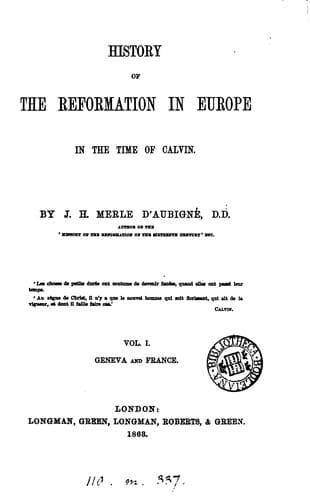
History of the Reformation in Europe in the Time of Calvin, Vol. 6 (of 8)Merle d'Aubigné, J. H. (Jean Henri)
History
History of the Reformation in Europe in the Time of Calvin, Vol. 6 (of 8)
Merle d'Aubigné, J. H. (Jean Henri)
Reformation
Matters were by that time far worse. Many foreigners, chiefly refugees,
did not take the supper. They were condemned to leave the town, ten
days only being allowed to them to set their affairs in order. The
councillors and other Genevese who had been guilty of the same offence
were obliged to apologize and to promise ‘to live from this time forth
according to the way of the town.’ These things did not pass without
lively altercations; and in consequence of a dispute which took place
in the street on the night of December 30, 1538, one man was killed
and many were wounded.[765] The most enraged of the refractory party,
thinking to justify their conduct in attacking the settled ministers,
called them infidels, corrupters of Scripture, and papists, who tried
to deceive the people. The pastors, who were certainly not possessed
of ability enough to fill the place of the eminent doctors banished by
the council, but who endeavored for the most part to do as much good
as their moral and intellectual qualities permitted, were greatly
annoyed, complained to the council, and desired to withdraw and make
room for others better qualified than themselves. ‘These reproaches,’
they said, ‘we find it very hard to bear.’ The council assured them
that it meant to keep them, and to reconcile them with their accusers.
[Sidenote: THE REGENTS OF THE COLLEGE.]
After this second act of discipline, or rather, at the same time, the
council undertook a third, of graver character still. In their eyes the
college was still a fortress in which Calvinism had entrenched itself,
with the intention of resisting the attacks of its adversaries. The
magistrate resolved to give the regents an opportunity of declaring
themselves, and if they offered resistance, to expel them. To join
the ministers who had succeeded Farel and Calvin, to administer the
supper with them, to do an act which those great doctors had refused
to do,--this was the requirement addressed by the magistrate to
Saunier, rector of the college, and to the three regents, Mathurin
Cordier, Vautier, and Vindos. It would have been straining a point
for them to take the supper; but to be in the number of those who
administered it, after all the controversies which had taken place, was
not this ‘to be an occasion of stumbling’ for many, and a taking part
against those venerated men whose absence they deplored? These four
professors therefore stated to the council that their conscience did
not allow them to do what was required. The magistrates ought to have
considered that this act is not within the province of the regents,
and that they ought not to do anything which might, by depriving the
college of the able men who directed it, possibly lead to its ruin.
But Richardet and his friends were despots who did not intend to allow
any resistance to their will. On the day after Christmas, they ordered
the rector and the three regents to quit Geneva in the space of three
days. Saunier was dismayed.
Public-domain text, read in full here on John Shaqi.
Reviews
Reviews
No reviews yet
Be the first to share your thoughts on this work.
Elsewhere in the archive
Join the Discussion
Join the discussion
Sign in to leave a comment or review.
Sign InorCreate an account