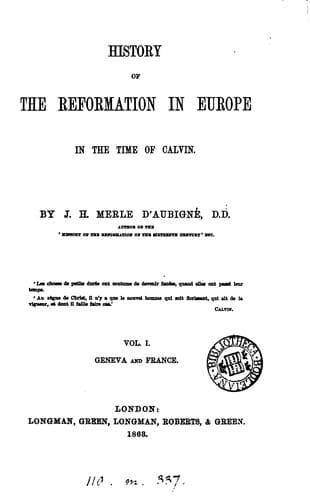
History of the Reformation in Europe in the Time of Calvin, Vol. 6 (of 8)Merle d'Aubigné, J. H. (Jean Henri)
History
History of the Reformation in Europe in the Time of Calvin, Vol. 6 (of 8)
Merle d'Aubigné, J. H. (Jean Henri)
Reformation
Rome, meanwhile, was not indifferent to what was taking place at
Geneva. Between the papacy and the Reformation there were action and
reaction, which kept both in constant agitation. When once the Catholic
reaction began, not content with mere resistance, it assumed the
offensive. The partisans of the pope, still pretty numerous in Geneva,
informed the Bishop de la Baume of what occurred in the town; and he,
who like all dispossessed princes was always expecting to be restored
to his episcopal see, the sweets of which he remembered better than the
bitterness, communicated with the pope. The latter gave to La Baume
the cardinal’s hat, in the hope that this dignity might be a bait to
draw the Genevese to place themselves once more under the crook of
their bishop. Then he invited the prelates who were nearest neighbors
to Geneva to take in hand the cause of their colleague. The Bishops of
Lyons, Besançon, Lausanne, Vienne, Turin, Langres and Carpentras, met
the Bishop of Geneva in the first of these towns. ‘The flock,’ they
said, ‘being now deprived of its pastors, men so eminent, we must seize
the opportunity to rescue it from the Reformation.’[787] Many Genevese
Catholics had emigrated to Lyons, and they spared no pains to bring
about the restoration of the prelate. Pierre de la Baume asked of his
colleagues ‘the recovery of his diocese.’ The Cardinal of Tournon,
the notorious persecutor of the Vaudois, and the introducer of the
Jesuits into France, who was at this time archbishop of Lyons, was
president of the meeting. He had thus an opportunity of satisfying his
inextinguishable passion against the _Calvinists_. Jean Philippe, chief
author of the banishment of Calvin, met with Tournon in the church
at Lyons, and carried on intrigues with him.[788] The affair might
perhaps have had a violent ending, but that a man was there present of
a different stamp from the archbishop. This was Cardinal Sadoleto, who,
as bishop Carpentras, a town in Dauphiné bordering on Savoy, seemed by
his neighboring position bound to concern himself more particularly
with Geneva. He was connected with Bembo, secretary to Leo X., was a
great lover of the classics, of philosophy and the arts, and was a man
of great eloquence, says Beza, but used it for extinguishing the true
light.[789] He very much regretted that the Reformation appeared to be
taking precedence of the Renaissance. He was, however, of more liberal
mind than adherents of the pope usually were. He loved Melanchthon. He
thought that it was not right to address the Genevese in the imperious
tone of a master, with dogmatic arguments of the school, or with the
intolerance of inquisitors, but rather in a polite style. Sadoleto was
therefore instructed to write a letter to the Genevese in which he was
to invite them mildly to return to the bosom of the Church. That the
contrivances and efforts of the pope, of the Bishop de la Baume, of the
Cardinal of Tournon and his colleagues, should issue only in a letter,
Public-domain text, read in full here on John Shaqi.
Reviews
Reviews
No reviews yet
Be the first to share your thoughts on this work.
Elsewhere in the archive
Join the Discussion
Join the discussion
Sign in to leave a comment or review.
Sign InorCreate an account