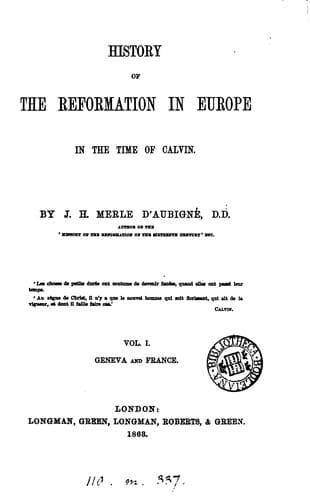
History of the Reformation in Europe in the Time of Calvin, Vol. 6 (of 8)Merle d'Aubigné, J. H. (Jean Henri)
History
History of the Reformation in Europe in the Time of Calvin, Vol. 6 (of 8)
Merle d'Aubigné, J. H. (Jean Henri)
Reformation
was rather a feeble conclusion.
Parturiunt montes, nascetur ridiculus mus.
[Sidenote: LETTER OF SADOLETO TO GENEVA.]
But they probably saw that they were powerless to do more. The
cardinal-bishop hoped to gain over the Genevese ‘by wheedling them with
fine words to turn them away from Jesus Christ,’ says a contemporary,
‘and by blaming the ministers of whom God had made use for reforming
the town.’[790] On March 26 his messenger, Jean Durand, of Carpentras,
was admitted into the hall of the council, and delivered the missive
addressed by his bishop to his _well-beloved brethren_ the syndics,
councils, and citizens of Geneva. There was not a word about the
conference at Lyons. ‘It has seemed good to the Holy Spirit and to me
to write to you. The reason is that while at Carpentras I have heard
reports concerning you which partly make me sad and partly give me
hope.’ Knowing how seductive flattery is, he writes the most beautiful
eulogy of Geneva. ‘I love the noble aspect of your town, the order and
form of your republic, the excellence of the citizens, and, above all,
the exquisite humanity which you display towards all foreign people
and nations.’ But by the side of this flattering picture he hastens
to place a portrait not so pleasing of the reformers. ‘Certain crafty
men, enemies of Christian union and peace, have cast into your town
the seeds of discord. I hear on one side the weeping, sighing, and
groaning of our holy Church. On the other side I perceive that these
innovators are not only pestilential to souls, but also pernicious in
a high degree to public and private affairs.’ Next he himself makes an
almost evangelical profession. He exalts the Word of God which, says
he, ‘does not entangle minds in difficult processes of reasoning; but,
a heavenly affection of the heart coming to its aid, offers itself with
clearness to our understandings.’ He exalts the work of Christ, ‘who
was willing to be our salvation, by suffering death in the flesh and
afterwards resuming an immortal life.’ He even exalts justification by
faith, _faith alone_, which all Roman controversialists curse. ‘This
everlasting salvation comes to us,’ said he, ‘by faith alone in God
and in Jesus Christ. When I say _by faith alone_, I do not mean that
charity and the duty of a Christian are dispensed with.’ Sadoleto was
undoubtedly sincere in these professions. He belonged, as is known,
to a small body of men feebly inclined towards the Gospel, who were
at that time supported by the papacy in the hope that they would be
the means of bringing back the Protestants. But he must have known
well that the doctrine of the reformers, far from dispensing with duty
and charity, asserted them, made them possible, and at the same time
necessary.
Public-domain text, read in full here on John Shaqi.
Reviews
Reviews
No reviews yet
Be the first to share your thoughts on this work.
Elsewhere in the archive
Join the Discussion
Join the discussion
Sign in to leave a comment or review.
Sign InorCreate an account