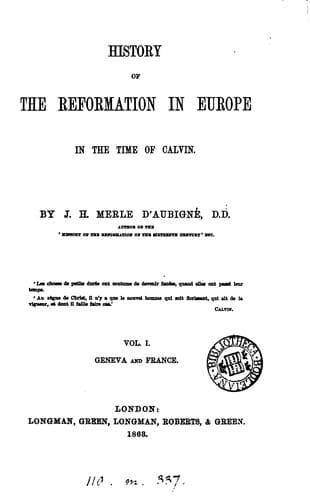
History of the Reformation in Europe in the Time of Calvin, Vol. 6 (of 8)Merle d'Aubigné, J. H. (Jean Henri)
History
History of the Reformation in Europe in the Time of Calvin, Vol. 6 (of 8)
Merle d'Aubigné, J. H. (Jean Henri)
Reformation
Among his hearers was a young maiden of noble birth who with joy
received the good news of salvation. Hamilton recognized in her a soul
akin to his own. He had adopted the principles of Luther on marriage;
he was familiar with the conversations which the reformer had with his
friends on the subject and which were reported all over Germany. ‘My
father and mother,’ said Luther one day, ‘lived in the holy state of
marriage, even the patriarchs and prophets did the same; why should
not I do so? Marriage is the holiest state of all, and the celibacy of
priests has been the cause of abominable sins. We must marry and thus
defy the pope, and assert the liberty which God gives us and which Rome
presumes to steal away.’[70] However, to marry was a daring step for
Hamilton to take, considering _the present necessity_, as speaks the
apostle Paul. As abbot of Ferne, and connected with the first families
of Scotland, his marriage must needs excite to the highest degree the
wrath of the priests. Besides which, it would call for great decision
on the part of Patrick and genuine sympathy on the part of the young
Christian maiden, to unite themselves as it were in sight of the
scaffold. The marriage however took place, probably at the beginning
of 1528. ‘A little while before his death,’ says Alesius, ‘he married
a noble young maiden.’[71] It is possible that the knowledge of this
union did not pass beyond the family circle. It remained unknown to his
biographers till our own time.[72]
While Hamilton was preaching at Linlithgow, archbishop Beatoun was
at the monastery of Dunfermline, about four leagues distant, on the
other side of the Forth. The prelate, when he learnt the return of
the young noble who had so narrowly escaped him, saw clearly that a
missionary animated with Luther’s spirit, thoroughly familiar with the
manners of the people, and supported by the powerful family of the
Hamiltons, was a formidable adversary. News which crossed the Forth
or came from Edinburgh, did but increase the apprehensions of the
archbishop. Beatoun was a determined enemy of the Gospel.[73] Having
governed Scotland during the minority of the king, he was indignant
at the thought of the troubles with which Hamilton’s preaching menaced
the Church and the realm. The clergy shared the alarm of their head;
the city of St. Andrews, especially, which one Scottish historian has
called ‘the metropolis of the kingdom of darkness’,[74] was in a state
of great agitation. The dean Spence, the rector Weddel, the official
Simson, the canon Ramsay and the heads of various monasteries consulted
together and exclaimed that peril was imminent, and that it was
absolutely necessary to get rid of so dangerous an adversary.
Public-domain text, read in full here on John Shaqi.
Reviews
Reviews
No reviews yet
Be the first to share your thoughts on this work.
Join the Discussion
Join the discussion
Sign in to leave a comment or review.
Sign InorCreate an account