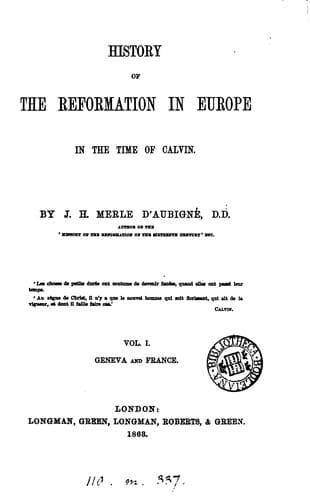
History of the Reformation in Europe in the Time of Calvin, Vol. 6 (of 8) — John Shaqi
History of the Reformation in Europe in the Time of Calvin, Vol. 6 (of 8)Merle d'Aubigné, J. H. (Jean Henri)
History
History of the Reformation in Europe in the Time of Calvin, Vol. 6 (of 8)
Merle d'Aubigné, J. H. (Jean Henri)
Reformation
He lost no time. Left perfectly free he went and came whithersoever
he would, and was allowed to defend his opinions without any obstacle
being thrown in his way. This was part of the plot. If the archbishop
himself were capable of some kindly feeling, his nephew David and
several others were pitiless. They wished Hamilton to speak, and
to speak a good deal; he must be taken in the very fact, that they
might dare to put him to death. Among those who listened to him there
were present, without his being aware of it, some who took notes
of his sayings and immediately made their report. His enemies were
not satisfied with letting him move about freely in private houses,
but even the halls of the university were opened to him; he might
‘teach there and discuss there openly,’ as an eyewitness tells
us,[76] respecting the doctrines, the sacraments, the rites and the
administration of the Church. Many people were pleased to hear this
young noble announce, with the permission of the primate of Scotland,
dogmas so strange. ‘They err,’ said Hamilton to his audience, ‘whose
religion consists in men’s merits, in traditions, laws, canons, and
ceremonies, and who make little or no mention of the faith of Christ.
They err who make the Gospel to be a law, and Christ to be a Moses. To
put the law in the place of the Gospel is to put on a mourning gown
in the feast of a marriage.’[77] Then he repeated what he had already
asserted at Marburg, what Luther had said, what Jesus Christ had
said:--‘It is not good works which make a good man; but it is a good
man who makes good works.’[78] It was above all for this proposition,
so Christian, so clear, that he was to be attacked.
The enemies of the young reformer exulted when they heard him avow
principles so opposed to those of Rome; but desirous of compromising
him still further, they engaged him in private conversations, in
which they tried hard to draw him to the extreme of his anti-Romish
convictions. Nevertheless, there were among his hearers righteous men
who loved this young Scotchman, so full of love for God and for men,
who went to his house, confided to him their doubts, and desired his
guidance. He received them with kindliness, frequently invited them to
his table, and sought to do good to them all.
[Sidenote: HIS DISCUSSION WITH ALESIUS.]
Public-domain text, read in full here on John Shaqi.
Reviews
Reviews
No reviews yet
Be the first to share your thoughts on this work.
Join the Discussion
Join the discussion
Sign in to leave a comment or review.
Sign InorCreate an account