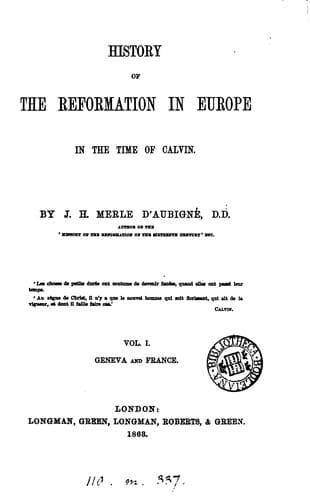
History of the Reformation in Europe in the Time of Calvin, Vol. 6 (of 8)Merle d'Aubigné, J. H. (Jean Henri)
History
History of the Reformation in Europe in the Time of Calvin, Vol. 6 (of 8)
Merle d'Aubigné, J. H. (Jean Henri)
Reformation
Hamilton rose early on the day on which he was to appear before the
bishop’s council.[94] Calm and yet fervent in spirit, he burned
with desire to make confession of the truth in the presence of that
assembly. Without waiting for the hour which had been fixed, he left
his abode and presented himself unexpectedly at the archbishop’s
palace, between seven and eight o’clock not long after sunrise. Beatoun
was already at his task, wishing to confer with the members of his
council before the sitting. They went and told him that Hamilton was
come and was asking for him. The archbishop took good care not to
give him a private interview. The several heresies of which Hamilton
was accused had been formulated. All who took part in the affair were
agreed as to the heads of the indictment. Beatoun resolved at once to
take advantage of Hamilton’s eagerness, and to advance the sitting. The
archbishop directed the court to constitute itself: each member took
his place according to his rank, and they had the accused before them.
One of the members of the council was commissioned to unfold before
the young doctor the long catalogue of heresies laid to his charge.
Hamilton was brought in. He had expected to converse with Beatoun in
private, but he found himself suddenly before a tribunal of sombre and
inquisitorial aspect; the lion’s jaws were open before him. However, he
remained gentle and calm before the judges, although he knew that they
had resolved to take away his life.
‘You are charged,’ said the commissioner, ‘with teaching false
doctrines: 1st, that the corruption of sin remains in the child after
baptism; 2nd, that no man is able by mere force of free will to do any
good thing; 3rd, that no one continues without sins so long as he is
in this life; 4th, that every true Christian must know if he is in the
state of grace; 5th, that a man is not justified by works but by faith
alone; 6th, that good works do not make a good man, but that a good
man makes good works; 7th, that faith, hope and charity are so closely
united that he who has one of these virtues has also the others; 8th,
that it may be held that God is cause of sin in this sense, that when
he withholds his grace from a man, the latter cannot but sin; 9th,
that it is a devilish doctrine to teach that remission of sins can be
obtained by means of certain penances; 10th, that auricular confession
is not necessary to salvation; 11th, that there is no purgatory; 12th,
that the holy patriarchs were in heaven before the passion of Jesus
Christ; and 13th, that the pope is Antichrist, and that a priest has
just as much power as a pope.’[95]
Public-domain text, read in full here on John Shaqi.
Reviews
Reviews
No reviews yet
Be the first to share your thoughts on this work.
Join the Discussion
Join the discussion
Sign in to leave a comment or review.
Sign InorCreate an account