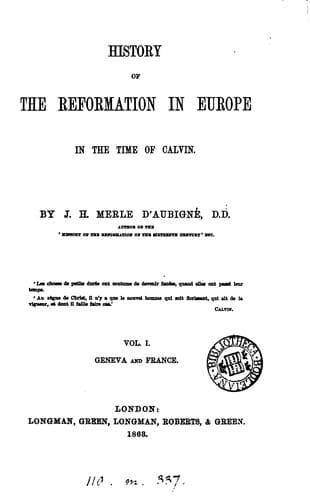
History of the Reformation in Europe in the Time of Calvin, Vol. 6 (of 8)Merle d'Aubigné, J. H. (Jean Henri)
History
History of the Reformation in Europe in the Time of Calvin, Vol. 6 (of 8)
Merle d'Aubigné, J. H. (Jean Henri)
Reformation
‘Before I will recant,’ he replied, laying his hand on his breast,
‘this body shall be burnt and the wind shall scatter its ashes.’ The
abbot, anxious to be rid of this innovator, gave him the parish of
Dollar.
Forrest was one of those men who receive the grace which is offered
them not only lovingly but with a vehement impetuosity. While many lay
sleeping he was vigorously going forward to take the kingdom of God.
There were in him those marvellous impulses, that grand earnestness,
which the Gospel denotes in the saying, ‘the violent take it by force.’
He used to study from six in the morning till midday: he learnt every
day three chapters of the Bible: in the afternoon visited families,
instructed his parishioners, and endeavored to bring souls to God. When
he returned in the evening to his vicarage, wearied with his labors, he
used to say to his servant, ‘Come, Andrew,’ and making him sit down
beside him, piously recited the three chapters of the Word of God which
he had learnt in the morning, hoping thus to fix them in his own memory
and to impress them on the soul of his servant.[191] A party of monks
having invaded his parish to sell indulgences there, Forrest went into
the pulpit and said, like Luther, ‘You cannot receive pardon for your
sins either from the pope or from any created being in the world, but
only by the blood of Jesus Christ.’
[Sidenote: FORREST AND THE BISHOP.]
His enemies hastened to denounce him to the bishop of Dunkeld, calling
upon him to put a stop to conduct so strange. ‘My joy dean Thomas,’
said the bishop to him, ‘I am told that you preach every Sunday. That
is too much. Take my advice, and don’t preach unless you find any
good gospel or any good epistle that setteth forth the liberty of
Holy Church.’--‘My lord,’ replied Forrest, ‘I would wish that your
lordship preach also every Sunday.’ ‘Nay, nay, dean Thomas,’ said
the bishop, alarmed, ‘let that be.’--‘Whereas your lordship biddeth
me preach,’ continued Forrest, ‘when I find any _good_ epistle, or a
_good_ gospel, truly, my lord, I have read the New Testament and the
Old, all the gospels, all the epistles, and among them all I could
never find an evil epistle or an evil gospel; but if your lordship
will shew me the good and the evil ones, I will preach the former and
pass over the latter.’ The bishop, more and more affrighted, exclaimed
with all his might,[192] ‘Thank God, I never knew what the Old and New
Testament was, and I will to know nothing but my _portuese_[193] and my
_pontifical_!’
For the moment Forrest escaped death. The bishop’s saying got abroad
in Scotland, and people used for a long time to say to any ignorant
person, ‘_Ye are like the bishop of Dunkeldene that knew neither new
nor old law_.’[194]
Public-domain text, read in full here on John Shaqi.
Reviews
Reviews
No reviews yet
Be the first to share your thoughts on this work.
Elsewhere in the archive