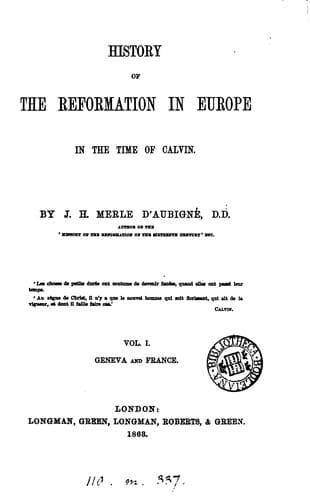
History of the Reformation in Europe in the Time of Calvin, Vol. 6 (of 8)Merle d'Aubigné, J. H. (Jean Henri)
History
History of the Reformation in Europe in the Time of Calvin, Vol. 6 (of 8)
Merle d'Aubigné, J. H. (Jean Henri)
Reformation
The discontent of the people with the clergy went on increasing, and
at a provincial council which met at Edinburgh in March, 1536, Sir
James Hamilton, in the king’s name, demanded various reforms. The men
of the kirk were indignant. ‘Never had they been so ill content,’ said
Angus.[195]
The monks, in alarm, began to attack the Reformation from their pulpits.
Bishop Barlow, the English envoy, thought the moment a favorable one
for reform in Scotland. ‘If I may obtain the king’s license,’ he wrote
to Cromwell, then first secretary of state to Henry VIII., ‘otherwise
shall I not be suffered to preach, I will not spare for no bodily
peril, boldly to publish the truth of God’s Word among them. Whereat
though the clergy shall repine, yet many of the lay people will gladly
give hearing. And until the Word of God be planted among them, I
suppose their feigned promises shall be finally found frustrate without
any faithful effect.’[196]
It seemed as if the hopes of the Anglican bishop were beginning to be
realized. It was rumored that the King of Scotland, offended at the
reception which his demands had met in the council, was going to have
a conference with his uncle. The prelates thought that if that project
were carried out they were undone. ‘Pray do not allow,’ they said to
the king, ‘a single word to be spoken by the King of England to induce
you to adopt his new constitutions of the Scripture.’[197] James was
willing and unwilling: but he yielded, and the interview with the
terrible Tudor was given up. But the bishops were not yet freed from
their alarm; they dreaded the influence of the English ambassadors, and
that of the queen-mother, and they feared that they might not be strong
enough another time. In order to confirm the prince in his resolution,
they conceived the plan of getting him to request a brief from the pope
to _forbid_ his holding intercourse with Henry VIII. Thompson, the
apostolic prothonotary, was secretly charged with this strange mission,
and the priests thought it a capital stroke to ask the King of England
to grant this agent a passport, taking good care to conceal from him
the object of the mission. Henry, not at all suspicious, agreed to
their request, and these cunning clerks could laugh together at their
paltry trick. But the queen-mother, when she became acquainted with
all these intrigues, sharply rebuked her son. Sensitive and violent,
as weak men frequently are, James forgot all respect, and accused his
mother of accepting gifts from the king her brother to betray the
king her son. Margaret indignantly declared that she would return to
London,[198] and the two English envoys hastened their departure from
Scotland. The Scottish clergy had been very much alarmed at the project
formed by Henry VIII. of giving his daughter Mary to his nephew; but
the daughter of Catherine of Aragon would not have been wanting in
submissiveness to the pope. The clerical party, having succeeded in
Public-domain text, read in full here on John Shaqi.
Reviews
Reviews
No reviews yet
Be the first to share your thoughts on this work.
Elsewhere in the archive
Join the Discussion
Join the discussion
Sign in to leave a comment or review.
Sign InorCreate an account