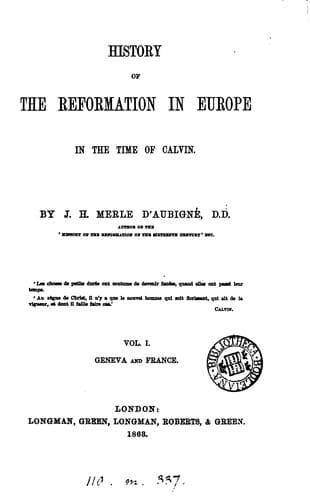
History of the Reformation in Europe in the Time of Calvin, Vol. 6 (of 8)Merle d'Aubigné, J. H. (Jean Henri)
History
History of the Reformation in Europe in the Time of Calvin, Vol. 6 (of 8)
Merle d'Aubigné, J. H. (Jean Henri)
Reformation
stirring up quarrels in the royal family, between the mother and the
son and between the uncle and the nephew, and anxious to make the
proposed union forever impossible, hinted to the young prince that the
eldest daughter of the King of France, the sister-in-law of Catherine
de’ Medici, would be for him a far more glorious and advantageous
alliance. This scheme pleased James, and when the rumor ran that the
emperor was on the point of invading France, the King of Scotland,
in order to win the favor of the father of the bride whom he desired,
offered to him the aid of his army.[199] Then he set sail, September
1, with six vessels, accompanied by a suite of five hundred persons,
all of noble or gentle birth. In ten days he reached Dieppe,[200] and
without consulting the opinion of his uncle, he asked for and obtained
the hand of Madame Madeleine, who had been very tenderly brought up
by her aunt, Margaret of Valois.[201] The Scottish priests were in
high glee, because in their view this alliance with France tended to
strengthen the papacy in Scotland; but their joy was premature. The
kings of France were beginning to assume an air of superiority towards
Scotland, which was offensive to a nation proud though small. It was
far worse afterwards, when Henry II., king of France, marrying his son
to Mary Stuart, required that princess to sign contracts which were
humiliating to ancient Caledonia.
[Sidenote: MADELEINE DE VALOIS.]
James had found in Madeleine an accomplished princess. Her health was
frail, but her heart was virtuous and her soul was no stranger to
the piety of her aunt. How great a gain for the Reformation if there
should be seated on the throne of Scotland a queen who was a lover
of the Word of God! James embarked with his young wife on a fleet of
seventeen sail. On reaching Leith, the amiable queen, who was of noble
bearing though of unhealthy aspect, set foot on land, knelt down on
the shore, and taking up a handful of the sand of Scotland, kissed it
with deep feeling, and implored God’s blessing on her beloved husband
and on her new country. Madeleine was received at Edinburgh with great
enthusiasm by the people and the nobles; but the churchmen, better
informed than they were at first, were disquieted, and were afraid that
this princess would diffuse around her the evangelical opinions of the
sister of Francis I. This happiness was not in store for Scotland.
The flower transplanted into that rough climate withered and fell.
On July 2 [1537] the queen breathed her last. All who had known her,
except the priests, deeply regretted her. Buchanan, struck with such
glory and such mourning, composed an epitaph on her in Latin verse,
to the following effect:--‘I was wife of a king, daughter of a king,
niece of a king, and, according to my wish and my hope, I was to become
mother of a king. But cruel death, unwilling that I should stand on the
highest pinnacle of honor that a mortal creature can attain to, has
Public-domain text, read in full here on John Shaqi.
Reviews
Reviews
No reviews yet
Be the first to share your thoughts on this work.
Elsewhere in the archive
Join the Discussion
Join the discussion
Sign in to leave a comment or review.
Sign InorCreate an account