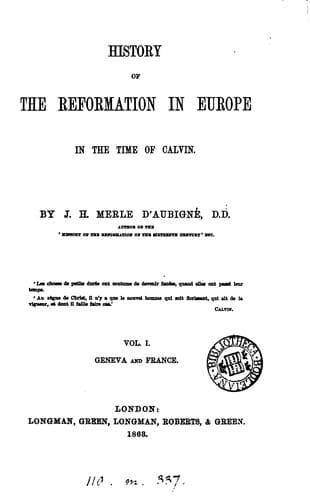
History of the Reformation in Europe in the Time of Calvin, Vol. 6 (of 8)Merle d'Aubigné, J. H. (Jean Henri)
History
History of the Reformation in Europe in the Time of Calvin, Vol. 6 (of 8)
Merle d'Aubigné, J. H. (Jean Henri)
Reformation
A man with whom we have already made acquaintance was now for
eight years to play a prominent part in Scotland, and to contend
energetically against the Reformation. This was David Beatoun, one
of the members of the Fifeshire family, and nephew of archbishop
James. He belonged to the class of minds which take their place
with enthusiasm under an absolute government, and become its most
formidable instruments. Thoroughly at home and highly esteemed at the
court of France, it was he who had conducted the negotiations for the
king’s marriage, first with Madeleine of Valois, afterwards with Mary
of Lorraine. But his intent was to devote his life to a union more
sublime--that of Scotland and the papacy. Animated with hearty sympathy
for Gregory VII., Boniface VIII., and Innocent III., he believed, as
they did, that Rome, formerly mistress of the pagan world, should now
be mistress of the Christian world. In his eyes all authority emanated
from her, and he was resolved to consecrate to her his life, his
energies, and everything that he possessed. As he meant to fight with
carnal weapons, he must attain some dignity which would invest him with
authority to make use of them. He speedily attained his end. Paul III.,
alarmed at seeing the separation of England from Rome, and fearing lest
Scotland, as she had a nephew of Henry VIII. for her king, should
follow her example, was anxious to have in that country one man who
would be absolutely devoted to him. David Beatoun offered himself.
The pope created him cardinal in December 1538, and thenceforth the
_red_, a color thoroughly congenial with him, became his own, and as
it were his symbol. Not that he was by any means a religious fanatic;
he was versed neither in theology nor in moral philosophy. He was a
hierarchical fanatic. Two points above all were offensive to him in
evangelical Christians: one that they were not submissive to the pope;
the other, that they censured immorality in the clergy, for his own
licentiousness drew on himself similar rebukes. He aimed at being in
Scotland a kind of Wolsey, only with more violence and bloodshed. The
one thing of moment in his eyes was that everything in church and state
should bend under a twofold despotism. Endowed with large intelligence,
consummate ability, and indomitable energy, he had all the qualities
needed to insure success in the aim on which his mind was perpetually
bent without ever being diverted from it. Passionately eager for his
projects, he was insensible to the ills which must result from them.
One matter alone preoccupied him: the destruction of all liberty. The
papacy divined his character, and created him cardinal.
Public-domain text, read in full here on John Shaqi.
Reviews
Reviews
No reviews yet
Be the first to share your thoughts on this work.
Elsewhere in the archive
Join the Discussion
Join the discussion
Sign in to leave a comment or review.
Sign InorCreate an account