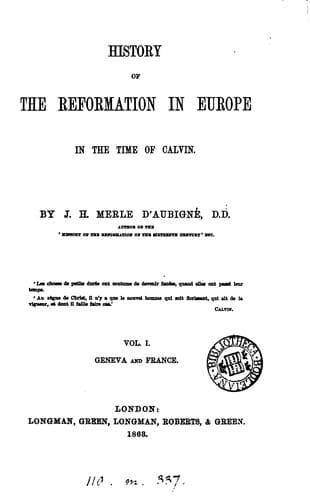
History of the Reformation in Europe in the Time of Calvin, Vol. 6 (of 8)Merle d'Aubigné, J. H. (Jean Henri)
History
History of the Reformation in Europe in the Time of Calvin, Vol. 6 (of 8)
Merle d'Aubigné, J. H. (Jean Henri)
Reformation
For the suppression of evangelical Christianity, which upheld the
supreme authority of the Divine Word in the presence of the tiara and
its oracles, Beatoun needed the royal support. His first step therefore
must be to make himself master of the king. This was not difficult. The
nobility had rights which they meant to make respected, and which the
crown wished to take away. The king and the cardinal were naturally
impelled to unite against the Gospellers and the nobles. In addition,
James V., a prince of good natural endowments both of body and of
mind, and of a frank and amiable disposition, was strongly inclined
to sensual pleasures. In order to keep him out of the way of state
affairs, the courtiers and the regent had fostered in him the taste for
intrigues and adventures of gallantry, a vice which he never got rid of
even after his marriage.[206] Dissolute as a man, prodigal as a king,
and superstitious as a Catholic, he could not but easily fall under the
sway of superior minds,[207] especially if they promised him money, and
that Beatoun could do.
Henry VIII., who, like his nephew, was habitually in want of money, had
sought it in the treasures of the monasteries and other ecclesiastical
institutions. The King of Scotland might be tempted to follow that
example. Beatoun, and the other ecclesiastical dignitaries who were
about the prince, discovered a certain means of preventing it. Instead
of taking the money of the clergy, they said, let the king take that of
the Gospellers; let the property of those who may be condemned to death
for their faith, and even that of those who, after having embraced
the Reform, may abjure it, be confiscated for his majesty’s benefit.
This scheme was all the more seductive in that, while it secured their
wealth to the clergy, it at the same time deprived the friends of the
Reformation of theirs. This was killing two birds with one stone. The
plan gives a special character to the Scottish persecutions. The cruel
Gardiner said in England, that when people went stag-hunting they
must fire at the leader of the herd, and that the same course must be
pursued in hunting the Gospellers. In Scotland it was agreed not to
harass those poor Christians who had nothing to leave at their death.
Why seize these lean sheep? The knife must be laid on the big fat
ones--on those which have a rich fleece. War on the rich! This was
the cry raised by the party of the persecutors. For about four years
the sword had not been drawn from its scabbard, and the horror excited
by the persecution of 1534 had, as it seemed, subsided. The Gospel
had reaped advantage from the lull: the number of those who confessed
Christ as their only Saviour had increased, and thus the irritation of
the priests was soon aroused again.
[Sidenote: WAR ON THE RICH.]
Public-domain text, read in full here on John Shaqi.
Reviews
Reviews
No reviews yet
Be the first to share your thoughts on this work.
Elsewhere in the archive
Join the Discussion
Join the discussion
Sign in to leave a comment or review.
Sign InorCreate an account