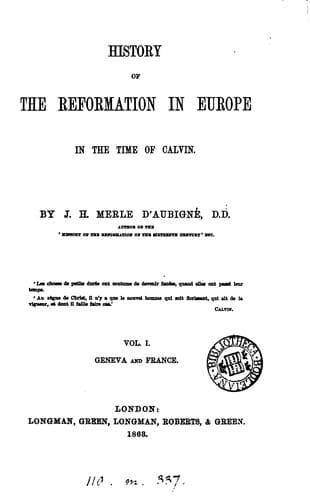
History of the Reformation in Europe in the Time of Calvin, Vol. 6 (of 8)Merle d'Aubigné, J. H. (Jean Henri)
History
History of the Reformation in Europe in the Time of Calvin, Vol. 6 (of 8)
Merle d'Aubigné, J. H. (Jean Henri)
Reformation
Norfolk was not wrong. The cardinal, having won over the king by
flattery and by the heavy fines extorted from the evangelical
Christians, was eager to take advantage of the circumstance for the
destruction of the Reform and the satisfaction of some grudges of
long standing. A monk named Killon, possessing some poetic talent,
had composed, after the fashion of the age, a tragedy on the death of
Christ. On the morning of Good Friday, probably in 1536, a numerous
audience had assembled at Stirling to hear it. The king himself and
the court were present. The piece presented a lively picture of the
spirit and the conduct of the Romish clergy. The action was animated,
the characters well marked, and the words vigorous and sometimes rude.
Fanatical priests and hard-hearted Pharisees instigated the people to
demand the death of Jesus, and procured from Pilate his condemnation.
The design of this work was so marked that the simplest folk said to
one another, ‘It is just the same with us: the bishops and the monks
get those persecuted who love Jesus Christ.’[213] The clergy abstained
for the moment from molesting Killon, but they took note of his daring
drama.
Another Gospeller had left very unpleasant memories in Beatoun’s mind.
This was the good dean Forrest, who had boldly said that he had never
found either a bad epistle or a bad gospel. The cardinal was only
waiting for an opportunity to arrest him, Killon, and others. He had
not long to wait. When the vicar of Tullybody, near Stirling, was
married, Forrest and Killon had attended the ceremony, as well as a
monk named Beverage, Sir Duncan Sympson, a priest, a gentleman named
Robin Forrester, and three or four other people of Stirling.[214]
At the marriage feast, at the beginning of Lent, they had eaten
flesh, according to that word of St. Paul, ‘Whatsoever is sold in
the shambles, that eat.’ On March 1, 1539, or according to some
authorities, on the last day of February,[215] they were all seized and
taken before the cardinal and the bishops of Glasgow and Dunkeld, who
indulged in practices far more criminal than the eating of what God
made for that purpose.
[Sidenote: PROSECUTION OF FORREST AND KILLON.]
The official accuser, John Lauder, one of Beatoun’s creatures,
addressing Forrest rudely, said to him--‘False heretic! thou sayest it
is not lawful to kirkmen to take their teinds [tithes] and offerings
and corpse presents.’ And the dean Forrest replied, ‘Brother, I said
not so: but I said it was not lawful to kirkmen to spend the patrimony
of the kirk as they do, as on riotous feasting and on fair women, and
at playing at cards and dice: and neither the kirk well maintained
nor the people instructed in God’s Word, nor the sacraments duly
administered to them as Christ commanded.’
_Accuser_: ‘Dare thou deny that which is openly known in the country?
that thou gave again to thy parishioners _the cow_ and the _upmost
cloths_, saying you had no right to them? ’
Public-domain text, read in full here on John Shaqi.
Reviews
Reviews
No reviews yet
Be the first to share your thoughts on this work.
Elsewhere in the archive
Join the Discussion
Join the discussion
Sign in to leave a comment or review.
Sign InorCreate an account