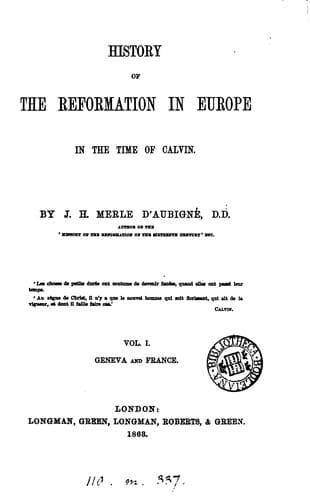
History of the Reformation in Europe in the Time of Calvin, Vol. 6 (of 8)Merle d'Aubigné, J. H. (Jean Henri)
History
History of the Reformation in Europe in the Time of Calvin, Vol. 6 (of 8)
Merle d'Aubigné, J. H. (Jean Henri)
Reformation
_Dean_: ‘I gave them again to them that had more mister [need] than I’
_Accuser_: ‘Thou false heretic! thou learned all thy parishioners to
say the Paternoster, the creed, and the Ten Commandments _in English_.’
_Dean_: ‘Brother, my people are so rude and ignorant they understand
no Latin, so that my conscience provoked me to learn them the words
of their salvation in English, and the Ten Commandments which are the
law of God, whereby they might observe the same. I teached the belief,
whereby they might know their faith in God and Jesus Christ his Son,
and of his death and resurrection. Moreover I teached them and learned
them the Lord’s own prayer in the mother-tongue, to the effect that
they might know how they should pray.’
_Accuser_: ‘Why did you that? By our acts and ordinances of our holy
father the pope?’
_Dean_: ‘I follow the acts of our master and Saviour Jesus Christ, and
of the apostle Paul, who saith that he had rather speak five words to
the understanding and edifying of his people than ten thousand in a
strange tongue which they understand not.’
_Accuser_: ‘Where finds thou that?’
_Dean_: ‘In my book here, in my sleeve.’
At these words the accuser, rushing at a bound on the dean, snatched
from his hands the New Testament, and holding it up, said with a loud
voice, ‘Behold, sirs, he has the book of heresy in his sleeve that
makes all the din and play in our kirk.’
_Dean_: ‘Brother, ye could say better if ye pleased, nor to call the
book of the Evangel of Jesus Christ the book of heresy.’
‘It is enough to burn thee for,’ said the accuser, coolly.[216]
Five of these pious men were immediately condemned to death and were
taken the same day to the castle hill, where the piles were ready; and
the king, following the example of Francis I., was present with his
court at this cruel execution.[217] Those who went first to the stake
piously and wonderfully consoled those who were to follow them. ‘At
the beginning of 1539,’ says Buchanan, ‘many suspected of Lutheranism
were arrested; five were burnt at the end of February, nine recanted,
and others were sentenced to banishment.’[218] The same day orders
were issued to confiscate the property of those who had been declared
heretics.[219] The king, the cardinals, and their subordinates took
their reward out of the penalties.
[Sidenote: GEORGE BUCHANAN.]
Public-domain text, read in full here on John Shaqi.
Reviews
Reviews
No reviews yet
Be the first to share your thoughts on this work.
Elsewhere in the archive
Join the Discussion
Join the discussion
Sign in to leave a comment or review.
Sign InorCreate an account