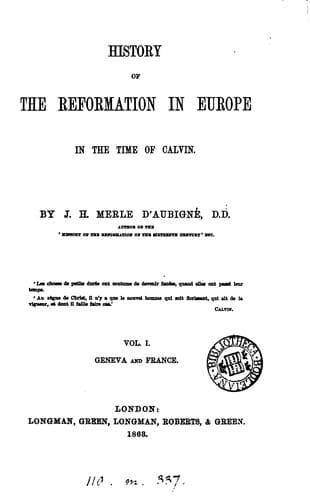
History of the Reformation in Europe in the Time of Calvin, Vol. 6 (of 8)Merle d'Aubigné, J. H. (Jean Henri)
History
History of the Reformation in Europe in the Time of Calvin, Vol. 6 (of 8)
Merle d'Aubigné, J. H. (Jean Henri)
Reformation
Beatoun, while sacrificing many victims, had lit a fire on elevated
ground, ‘to the effect that the rest of the bischoppes myght schaw
thame selfis no less fervent to suppress the light of God.’[224] That
signal was not made in vain. In the town of Ayr, in the midst of
the rich plains of that fertile county, was a young gentleman named
Kennedy, about eighteen years of age, who had received a liberal
education, and had tasted of the Gospel, without however attaining a
well-grounded faith; a state sufficiently accounted for by his years.
Gifted with some poetic faculty he had not spared the ignorance of the
priests. Kennedy was seized and cast into prison.
In the same diocese, that of Glasgow, there lived in a convent of the
Cordeliers one of those enlightened and pious monks who shone like
stars in the deep night of the age. His name was Jerome Russel; his
character was good, his wit ready, and his mind enriched with literary
acquirements. Wharton, writing to Lord Cromwell in November 1538,
speaks of a friar John, a well-informed man who was imprisoned at
Dumfries at the instance of the bishops, and who had been loaded with
chains because he professed respecting the law of God the same opinions
which were held in England.[225] It is not to be doubted that he speaks
of Russel. Dumfries is not far from Ayr.
The archbishop of Glasgow, Gawin Dunbar, was not of so persecuting a
spirit as Beatoun, and as lord chancellor he was invested with the
highest authority in the state. It was then the summer of 1539, and as
Beatoun, although named cardinal, had not yet received the pontifical
act which conferred on him that dignity, he could not have dared to
appear in the diocese of Glasgow with his cross borne before him. But
it was not enough for him to know that the learned Russel and the young
Kennedy were in prison, he must get them burnt. Consequently he sent to
Glasgow his favorite agent Lauder, who could affect insinuating manners
and put on exaggerated pretensions to compass his ends. The clever
notary Andrew Oliphant and the ardent monk Mortman accompanied him,
charged to obtain from the archbishop the promise ‘that he would imbrue
his hands in the blood of the friends of God.’ Knox therefore calls
these three men _Satan’s sergeants_.
[Sidenote: TRIAL OF KENNEDY AND RUSSEL.]
Public-domain text, read in full here on John Shaqi.
Reviews
Reviews
No reviews yet
Be the first to share your thoughts on this work.
Elsewhere in the archive
Join the Discussion
Join the discussion
Sign in to leave a comment or review.
Sign InorCreate an account