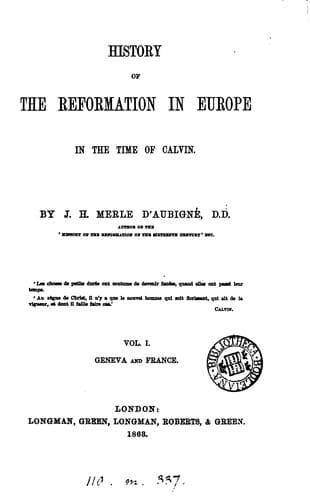
History of the Reformation in Europe in the Time of Calvin, Vol. 6 (of 8)Merle d'Aubigné, J. H. (Jean Henri)
History
History of the Reformation in Europe in the Time of Calvin, Vol. 6 (of 8)
Merle d'Aubigné, J. H. (Jean Henri)
Reformation
The illustrious Buchanan was himself in prison at that time. He was
thirty-two years of age, and after a residence at the university of
Paris, he had returned to Scotland and had been named preceptor to
the earl of Murray, a natural son of James V. He was a poet as well
as a historian, and his genius grew and developed itself under the
influence of the classical poetry which charmed his leisure hours.
There was something sharp and biting in his temperament, peculiarly
apt for satire; and he had not spared the clergy in his _Somnium_, his
_Palinode_, and above all in his satire against the _Franciscans_. It
was for this last poem he was imprisoned. The companies of monks had
keenly resented his sarcasm, and there was not a man in all Scotland
whose death was more eagerly desired by the Romish party. It was said
that the cardinal offered the king a considerable sum of money in
order to compass it. However that may be, Buchanan was at that time
a prisoner and was carefully watched in the prison of St. Andrews,
some of the guards even spending the night in his room. The young man,
already an illustrious writer, knew that they were seeking his life;
the death of five martyrs showed him clearly enough the fate which
awaited himself. One night he perceived that his keepers had fallen
asleep.[220] He went on tiptoe towards the window, and climbing up
the walls, succeeded, although with difficulty, in getting out. He
then passed on and surmounted other obstacles as great;[221] and thus
by the aid of God, and stimulated by the desire of saving his life,
‘he escaped the rage of those that sought his blood.’[222] He betook
himself to France, taught for several years in the Collège de Guienne
at Bordeaux, and afterwards in a college at Paris. Henry Stephens,
when he published at Paris the first edition of Buchanan’s Paraphrase
of the Psalms, calls him on the title-page of the book, ‘Poetarum
nostri sæculi facile princeps.’ His escape took place, as nearly as we
can learn, in March 1539. Many Gospellers, as we have said, followed
the example of Buchanan that same month. As for himself, he appears
at that period of his life to have been nothing more than one of the
numerous poets and prose-writers who were then attacking the vices and
the follies of the Romish clergy. But while attacking superstition,
Buchanan did not fall as many did into infidelity: he adhered heartily
at a later period to the evangelical reform, and Knox bears noble
witness to him.[223]
Public-domain text, read in full here on John Shaqi.
Reviews
Reviews
No reviews yet
Be the first to share your thoughts on this work.
Elsewhere in the archive
Join the Discussion
Join the discussion
Sign in to leave a comment or review.
Sign InorCreate an account