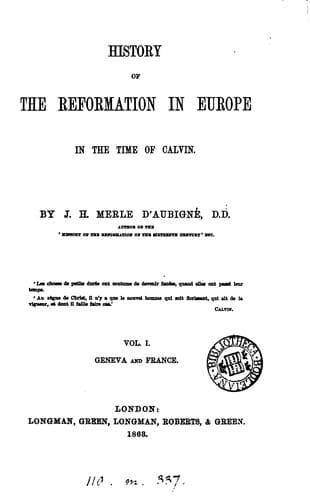
History of the Reformation in Europe in the Time of Calvin, Vol. 6 (of 8)Merle d'Aubigné, J. H. (Jean Henri)
History
History of the Reformation in Europe in the Time of Calvin, Vol. 6 (of 8)
Merle d'Aubigné, J. H. (Jean Henri)
Reformation
The Romish party was not yet satisfied. ‘These cruel beasts,’ says
Knox, ‘did intend nothing but murder in all quarters of the realm.’
James was surrounded with men who urged him on in that direction.
Many of his courtiers, associates of his dissipation, instigated
him to persecution because they were pensioners to priests for that
purpose.[228] Oliver Sinclair was the foremost of these secret tools
of the clergy. The cardinal’s influence was increased by circumstances
which occurred at this time. Archbishop James Beatoun died in the
autumn of 1539, after having attended as a witness at the baptism of
the king’s eldest son. By his last will he left his archbishopric of
St. Andrews to his nephew David, who, when confirmed by the king, was
thenceforth both cardinal and primate of Scotland.
[Sidenote: JAMES V. AND HIS BISHOPS.]
Henry VIII. was induced by these changes to take fresh steps towards
gaining over his nephew. He was acquainted with the cardinal, and knew
his relations with France and the papacy. At the beginning of 1540
Sir R. Sadler was sent to Scotland.[229] The moment was well chosen.
James V. was just then fully disposed to make peace with his uncle.
The Lords Murray, Huntley, and Bothwell were in disgrace, and James
wrote to Henry VIII. as his ‘dearest brother and uncle,’ and commended
himself to him in his most hearty and affectionate manner. Henry sent
him presents and the most gracious messages, inquiring earnestly after
his health; and all this courtesy James received in the most amiable
manner imaginable. Henry however meant to go to the main point, and
Thomas Eure, one of his envoys, strove to discover what were the
purposes of the King of Scotland respecting the bishop of Rome and the
Reformation. One of the councillors, Ballenden, replied to him with
great politeness, ‘The King of Scottes himself, with all his temporall
counsaile, was gretely geven to the reformation of the mysdemeanors of
busshops, religious personnes, and priests within the realme.’[230]
James gave even then some proofs of this disposition. On the day of
the Epiphany, January 6, 1540, there was a grand feast at the court,
and a dramatic spectacle was given in the palace of Linlithgow. The
king, the queen, and all the councillors spiritual and temporal were
present; and the purport of the piece was to exhibit the presumption of
the bishops, the iniquities of the courts spiritual, the evil ways of
the priests, and in one word, the ‘noughtines’ of such religion as then
existed. Perhaps the king was minded to let the bishops hear a sermon
in that shape. It is very unlikely that anyone would have dared to give
such a spectacle without his authority. However that may be, James was
struck with it; and when the piece was finished, he had the archbishop
in Glasgow, chancellor of the realm, called to him, as well as the
other bishops, whose thoughts and fears during the representation may
be imagined. ‘I exhort you,’ said the king to them, ‘to reform your
Public-domain text, read in full here on John Shaqi.
Reviews
Reviews
No reviews yet
Be the first to share your thoughts on this work.
Elsewhere in the archive
Join the Discussion
Join the discussion
Sign in to leave a comment or review.
Sign InorCreate an account