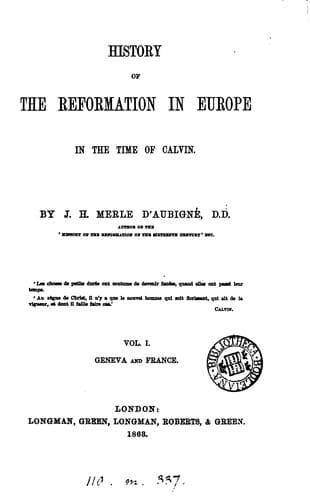
History of the Reformation in Europe in the Time of Calvin, Vol. 8 (of 8)Merle d'Aubigné, J. H. (Jean Henri)
History
History of the Reformation in Europe in the Time of Calvin, Vol. 8 (of 8)
Merle d'Aubigné, J. H. (Jean Henri)
Reformation
The mother of Charles V. was plunged into the deepest melancholy by
the treatment to which she was subjected. Her days were a constant
succession of sorrows. Her passage through life was from one suffering
to another. All her desire was to get out of that horrible prison;
and in striving to attain this object she displayed much good sense,
earnestness, and perseverance. She begged the marquis of Denia to
allow her to quit Tordesillas, at least for a time. She wished to go
to Valladolid. She alleged as a reason the bad air she breathed and
the acute sufferings it caused her. Her health required a change of
air, and she must at least undertake a journey. Her deep feeling moved
her barbarous jailer himself. For a moment pity touched that heart of
stone. 'Her language is so touching,' wrote Denia to the emperor, 'that
it becomes difficult for the marchioness and myself to withstand her
appeals. It is impossible for me to let any one go near her, for not a
man in the world could resist her persuasion. Her complaints awaken in
me deep compassion, and her utterances might move stones.'[209] This
is not how Denia would have written to Charles if he had been speaking
of a mad woman. Moreover he requested him to destroy his letters. At
times she remained silent; and we know that the grief which does not
utter itself is only the more fatal to the sufferer. At other times
her distress broke forth. One day (April, 1525) she contrived to find
access to the corridor and filled it with her sighs and moanings,
shedding the while floods of tears. Denia gave orders immediately that
she should be taken into her narrow chamber, so that she might not be
heard.[210] At the same time he wrote to Charles V.: 'I have always
thought that in her highness's state of indisposition, nothing would
do her more good than the rack; and after this that some _good_ and
loyal servant of your majesty should speak to her. It is necessary to
see whether she will not _make any progress_ in the things which your
majesty desires.' By these things he means confession, the mass, and
other Roman rites.
In 1530, despairing of seeing the queen confess, 'I can not believe,'
he wrote, 'that so fortunate a thing can happen. However, I will use
all needful endeavors.'
The officers of Charles V., and the monks who had incessantly labored
for the conversion of Joanna to Romanism, multiplied their efforts
as her death approached. She withstood their pressing entreaties to
receive the rites, the symbols of the papacy, and people heard the
cries which she uttered while they put her to torture. She would have
neither confession nor extreme unction.
[Sidenote: DEATH OF JOANNA.]
Public-domain text, read in full here on John Shaqi.
Reviews
Reviews
No reviews yet
Be the first to share your thoughts on this work.
Elsewhere in the archive
Join the Discussion
Join the discussion
Sign in to leave a comment or review.
Sign InorCreate an account