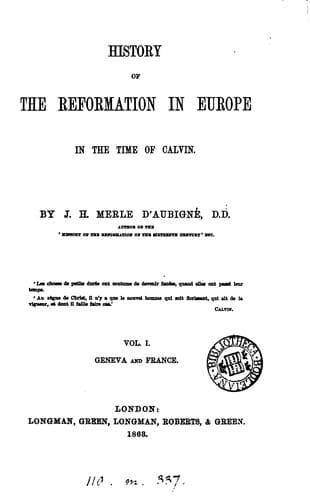
History of the Reformation in Europe in the Time of Calvin, Vol. 8 (of 8)Merle d'Aubigné, J. H. (Jean Henri)
History
History of the Reformation in Europe in the Time of Calvin, Vol. 8 (of 8)
Merle d'Aubigné, J. H. (Jean Henri)
Reformation
Had Joanna become acquainted with the Reformation and the writings
of the Reformers, and with the doctrines which they professed? This
has been doubted; but it seems improbable that she should have been
ignorant of them. Joanna was a Lutheran, says one of the learned
writers who have devoted most attention to this subject.[211] This
statement is perhaps too definite. But the evangelical doctrines were
penetrating everywhere; and they must have reached the prison of
Joanna. It has been asserted that Luther at this time had more numerous
adherents in Spain than in Germany itself.[212] The keepers of the
prison perhaps prevented evangelical works from reaching the queen.
There is, however, a light which no hand of man can intercept. The
theologian de Soto, celebrated for his acquirements, as well as for his
piety, came to her on the morning of her death; and he appears to have
thought her a Christian, but not a Roman Catholic. He said: '_Blessed
be the Lord, her highness told me things which have consoled me_.' Here
is the Christian. He adds: '_Nevertheless, she is not disposed to the
sacrament of the Eucharist_.' Here is the enlightened woman who rejects
the rites of Rome. 'She committed her soul to God,' said the princess
Joanna, granddaughter of the queen, 'and gave thanks to Him that at
length He delivered her from all her sorrows.' Her last words were:
'_Jesus Christ crucified, be with me_.'[213] She breathed her last on
April 12, 1555, between five and six o'clock in the morning.
Thus died the mother of Charles V. at the age of seventy-six years.
She had been at various times kept in prison by her husband, Philip of
Austria; for ten years by her father, Ferdinand the Catholic; and for
thirty-nine years by her son, the emperor Charles V. She is a unique
example of the greatest misfortunes, and her dark destiny surpasses all
the stories of ancient times. The heiress of so many famous kingdoms,
treated as the most wretched of women, was in her last year strictly
confined in her dungeon, and lay in the midst of filth which was never
removed. Covered as she was with tumors, in anguish and solitude, can
we wonder that strange and terrifying images were sometimes produced in
her brain by her isolation, melancholy, and fear? But while she was the
victim of the gloomiest fanaticism ever met with in the world, she was
consoled in the midst of all these horrors, as her latest words prove,
by her God and Father in heaven.
The time has come for posterity to render to her memory the compassion
and the honor which are her due.
BOOK XV.
ENGLAND.
CHAPTER I.
THE THREE PARTIES WHICH DIVIDED ENGLAND.
(1536-1540.)
Public-domain text, read in full here on John Shaqi.
Reviews
Reviews
No reviews yet
Be the first to share your thoughts on this work.
Elsewhere in the archive
Join the Discussion
Join the discussion
Sign in to leave a comment or review.
Sign InorCreate an account