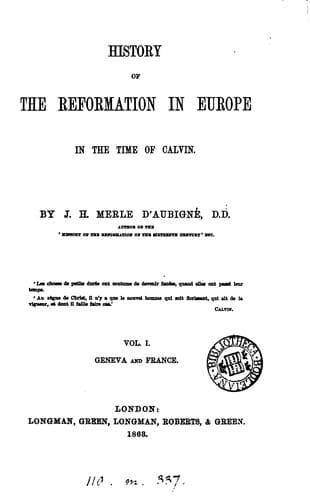
History of the Reformation in Europe in the Time of Calvin, Vol. 8 (of 8)Merle d'Aubigné, J. H. (Jean Henri)
History
History of the Reformation in Europe in the Time of Calvin, Vol. 8 (of 8)
Merle d'Aubigné, J. H. (Jean Henri)
Reformation
There were in 1536 three distinct parties in England, the papists, the
evangelicals, and the Anglican Catholics, who were halting between the
two extremes. It was a question which of the three would gain the upper
hand.
The Reformation in England was born of the power of the Word of God,
and did not encounter there such obstacles as were raised against it in
France by a powerful clergy and by princes hostile to evangelical faith
and morality. The English prelates, weakened by various circumstances,
were unable to withstand an energetic attack; and the sovereign was
'the mad Harry,' as Luther had called him.[214] His whims opened the
doors to religious freedom, of which the Reformation was to take
advantage. Thus England, which had remained in a state of rudeness
and ignorance much longer than France, was early enlightened by the
Reformation; and the nation awakened by the Gospel gave birth in the
sixteenth century to such master minds as France, though more highly
civilised, failed to produce so early. Shakespeare was born in 1563,
one year before the death of Calvin. The Reformation placed England a
century ahead of the rest of Europe. The final triumph, however, of
the Reformation was not reached without many conflicts; and the two
adversaries more than once engaged hand to hand, before one overthrew
the other.
[Sidenote: BIRTH OF EDWARD VI.]
About the middle of October, 1537, an event occurred which was of
great importance for the triumph of the Gospel. There was at that
time great rejoicing in the palace of the Tudors and in all England,
for Queen Jane (Seymour), on October 12, presented to Henry VIII. the
son which he had so much desired. Letters written beforehand, in the
name of the Queen, announced it in every place, and congratulations
arrived from all quarters. This birth was called 'the most joyful news
which for many years had been announced in England.' Bishop Latimer
wrote: 'Here is no less joying and rejoicing in these parts for the
birth of our prince, whom we hungered so long, than there was, I trow,
_inter vicinos_ at the birth of St. John Baptist.'[215] (Luke i. 58.)
_Princeps natus ad imperium!_ exclaimed the politicians. 'God grant him
long life and abundant honors!' they wrote from the Continent. Henry
was anxious that people should believe in this future. 'Our prince,'
Cromwell sent word to the ambassadors of England, 'our Lord be thanked,
is in good health, and sucketh like a child of his puissance, which
you my lord William can declare.'[216] It was all the more important
to declare this, because the very contrary was asserted. It was even
reported by some that the child was dead. As Henry feared that some
attempt might be made on his son's life, he forbade that any one should
approach the cradle without an order signed by his own hand. Every
thing brought into the child's room was to be perfumed, and measures
of precaution against poison were taken. The infant was named Edward;
Public-domain text, read in full here on John Shaqi.
Reviews
Reviews
No reviews yet
Be the first to share your thoughts on this work.
Elsewhere in the archive
Join the Discussion
Join the discussion
Sign in to leave a comment or review.
Sign InorCreate an account