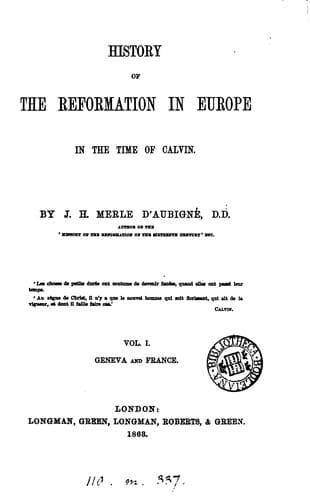
History of the Reformation in Europe in the Time of Calvin, Vol. 8 (of 8)Merle d'Aubigné, J. H. (Jean Henri)
History
History of the Reformation in Europe in the Time of Calvin, Vol. 8 (of 8)
Merle d'Aubigné, J. H. (Jean Henri)
Reformation
No sooner was he there than, under great excitement about what had
occurred to him at Paris, he wrote to Cromwell, complaining bitterly
that Henry VIII., in order to get him into his power, did not scruple
to violate both God's law and man's, and even 'to disturb all commerce
between country and country.' 'I was ashamed to hear that ... a prince
of honor should desire of another prince of like honor, Betray thine
own ambassador, betray the legate, and give him into my ambassador's
hands to be brought to me.'[236] The like, he says, was never heard
of in Christendom. Pole had more hope of the emperor than of Francis
I.; but he was soon undeceived. He was not permitted to go out of
the town; and a courier entrusted with his despatches was arrested
by the Imperialists at Valenciennes and sent back to him. He now
resolved on taking a step towards opening communication with the
English government; and as he did not venture to present himself to
the ambassadors of Henry VIII. in France, he sent to them the bishop
of Verona. But this prelate, likewise, was not received, and he was
only allowed to speak to one of the secretaries. He endeavored to
convince him of the perfect innocence of Pole and of his mission. 'The
cardinal-legate,' he said, 'is solely charged by the pope to treat of
the safety of Christendom.' This was true in the sense intended by
Rome; but it is well known what this safety, in her view, required.
Fresh movements in the north of England tended to increase the anger of
Henry VIII. It was not enough that Pole had been driven from France.
The king now wrote himself to Hutton, his envoy at Brussels--'You shall
deliver unto the regent our letters for the stay of his entry into the
emperor's dominions; ... you shall press them ... neither to admit him
to her presence, nor to suffer unto him to have any other entertainment
than beseemeth the traitor and rebel of their friend and ally....
You shall in any wise cause good secret and substantial espial to be
made upon him from place to place where he shall be.'[237] Pole, on
his part, spoke as a Roman legate. He summoned the queen to prove her
submission to the apostolic see, and to grant him an audience; and he
made use of serious menaces. 'If traitors, conspirators, rebels, and
other offenders,' said the English ambassador, 'might under the shadow
of legacie have sure access into all places, and thereby to trouble
and espy all things, that were overmuch dangerous.'[238] Here was no
question of rebellion, Pole sent word to the regent by the bishop of
Verona, but of the Reformation; and he was sent to refute the errors
which it was spreading in England. Her opinion was that he should
return, 'for that she had no commission of the emperor to intermeddle
in any point of his legacy.'[239]
Public-domain text, read in full here on John Shaqi.
Reviews
Reviews
No reviews yet
Be the first to share your thoughts on this work.
Elsewhere in the archive
Join the Discussion
Join the discussion
Sign in to leave a comment or review.
Sign InorCreate an account