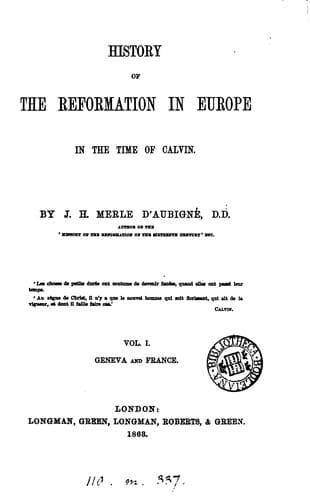
History of the Reformation in Europe in the Time of Calvin, Vol. 8 (of 8)Merle d'Aubigné, J. H. (Jean Henri)
History
History of the Reformation in Europe in the Time of Calvin, Vol. 8 (of 8)
Merle d'Aubigné, J. H. (Jean Henri)
Reformation
Bishop Sampson, one of Gardiner's allies, was a staunch friend of
ancient superstitions, and attached especial importance to the
requirement that God should not be addressed in a language understood
by the common people. 'In all places,' he said, 'both with the Latins
and the Greeks, the ministers of the church sung or said their offices
or prayers in the Latin or Greek grammatical tongue, and not in the
vulgar. That the people prayed apart in such tongues as they
would... and he wished that all the ministers were so well learned that
they understood their offices, service or prayers which they said in the
Latin tongue.'[256] In his view, it was not lawful to speak to God
except _grammatically_.
Sampson, a weak and narrow-minded man, was swayed by prejudices and
ruled by stronger men; and he had introduced in his diocese customs
contrary to the orders of the king. Weak minds are often in the van
when important movements are beginning; the strong ones are in the
rear and urge them on. This was the case with Sampson and Gardiner.
Cromwell, who had a keen and penetrating intellect, and whose glance
easily searched the depths of men's hearts and pierced to the core
of facts, perceived that some project was hatching against the
Reformation; and as he did not dare to attack the real leaders, he
had Sampson arrested and committed to the Tower. The bishop was not
strong-minded and trembled for a slight cause; it may, therefore, be
imagined how it was with him when he found himself in the state prison.
He fell into great trouble and extraordinary dejection of mind.[257]
His imagination was filled with fatal presentiments, and his soul was
assailed by great terrors. To have displeased the king and Cromwell,
what a crime! One might have thought that he would die of it, says a
historian. He saw himself already on the scaffold of Bishop Fisher and
Sir Thomas More. At this time the powerful minister summoned him to
his presence. Sampson admitted the formation of an alliance between
Gardiner, Stokesley, Tonstall and himself to maintain the old religion,
its traditions and rites, and to resist any innovation. He avowed the
fact that his colleagues and himself stood pledged to put forth all
their efforts for the restoration of degenerated Catholicism. In their
opinion, nothing which the Greeks had preserved ought to be rejected
in England. One day when Bishop Sampson was passing over the Thames in
a barge, in company with the bishop of Durham, to Lambeth Palace, the
latter produced an old Greek book which he used to carry in his pocket,
and showed Sampson several places in that book wherein matters that
were then in controversy were ordained by the Greek Church.[258] These
bishops, who spoke so courageously to each other, did not speak so with
the king. They feigned complete accordance with him; and for him they
had nothing but flatteries. Cranmer was not strong, but at least he was
never a hypocrite. Sampson, however, exhibited so much penitence and
Public-domain text, read in full here on John Shaqi.
Reviews
Reviews
No reviews yet
Be the first to share your thoughts on this work.
Elsewhere in the archive
Join the Discussion
Join the discussion
Sign in to leave a comment or review.
Sign InorCreate an account