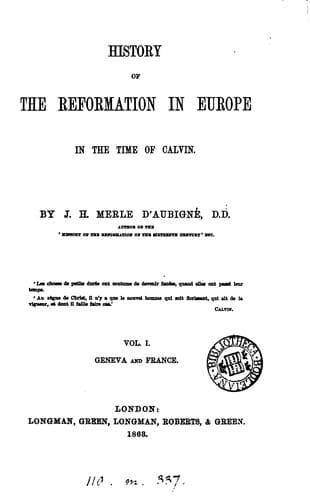
History of the Reformation in Europe in the Time of Calvin, Vol. 8 (of 8)Merle d'Aubigné, J. H. (Jean Henri)
History
History of the Reformation in Europe in the Time of Calvin, Vol. 8 (of 8)
Merle d'Aubigné, J. H. (Jean Henri)
Reformation
promised so much submission that he was liberated. But Cromwell now
knew what to think of the matter. A conspiracy was threatening the work
which he had been at so much pains to accomplish. He observed that the
archbishop's influence was declining at court, and he began to have
secret forebodings of calamity in which he would be himself involved.
Gardiner, in fact, energetically urged the king to re-establish all
the ancient usages. Thus, although but a little while before orders
had been given to place bibles in the churches, and to preach against
pilgrimages, tapers, kissing of relics, and other like practices,[259]
it was now forbidden to translate, publish, and circulate any religious
works without the king's permission; and injunctions were issued for
the use of holy water, for processions, for kneeling down and crawling
before the cross, and for lighting of tapers before the _Corpus
Christi_. Discussions about this sacrament of the Eucharist were
prohibited.[260] It was Gardiner's wish to seal these ordinances with
the blood of martyrs. He had begun by striking _in anima vili_; the
persecution of the Dutch sacramentarians was merely the _exordium_; it
was needful now to proceed to the very action itself, to strike a blow
at an evangelical and esteemed Englishman, and to invest his death with
a certain importance.
[Sidenote: JOHN NICHOLSON.]
There was at this time in London, a minister named John Nicholson,
who had studied at the university of Cambridge, had been converted by
means of his conversations with Bilney, and had afterwards been the
friend of Tyndale and Frith, and by his intercourse with them had been
strengthened in the faith. He was a conscientious man, who did not
suppose that it was enough to hold a doctrine comformable with the Word
of God, but, conscious of the great value of the truth, was ready to
lay down his life for it, even if there were nothing at stake but a
point looked upon as secondary. Faithfulness or unfaithfulness to one's
convictions--this was in his view the decisive test of the morality
or immorality of a man. In the age of the Reformation there were
greater preachers and greater theologians than Nicholson; but there
was not one more deserving of honor. Having translated from the Latin
and the Greek works which might give offence, and having professed his
faith, he had been obliged to cross the sea, and he became chaplain to
the English house at Antwerp. Here it was that he became acquainted
with Tyndale and Frith. Being accused of heresy by one Barlow, he
was taken to London, by order of Sir Thomas More, then chancellor,
and was kept prisoner at Oxford, in the house of Archbishop Warham,
where he was deprived of every thing, especially of books. On the
occasion of his appearance, in 1532, before the archbishop and other
prelates, Nicholson steadfastly maintained that all that is necessary
to salvation is to be found in the Holy Scripture. 'This,' he said, 'is
Public-domain text, read in full here on John Shaqi.
Reviews
Reviews
No reviews yet
Be the first to share your thoughts on this work.
Elsewhere in the archive
Join the Discussion
Join the discussion
Sign in to leave a comment or review.
Sign InorCreate an account