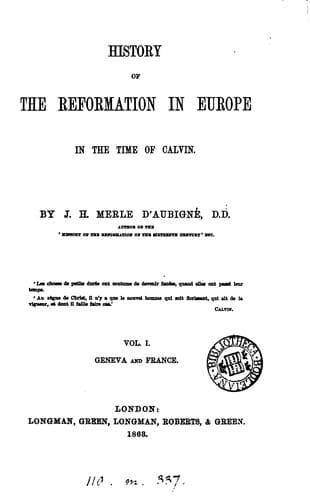
History of the Reformation in Europe in the Time of Calvin, Vol. 8 (of 8)Merle d'Aubigné, J. H. (Jean Henri)
History
History of the Reformation in Europe in the Time of Calvin, Vol. 8 (of 8)
Merle d'Aubigné, J. H. (Jean Henri)
Reformation
Gardiner did not lose a minute, but promptly took the business in
hand, because he saw in it an opportunity of striking a heavy blow;
and, what was an inestimable advantage, he would have on his side,
he thought, Cranmer and the other three evangelical divines. He
therefore 'went straight to the king,'[263] and requesting a private
audience, addressed him in the most flattering terms. Then, as if the
interests of the king were dearer to him than to the king himself, he
respectfully pointed out that he had everywhere excited by various
recent proceedings suspicion and hatred; but that at this moment a
way was open for pacifying men's minds, 'if only in this matter of
John Lambert, he would manifest unto the people how strictly he would
resist heretics; and by this new rumor he would bring to pass not only
to extinguish all other former rumors, and as it were with one nail to
drive out another, but also should discharge himself of all suspicion,
in that he now began to be reported to be a favorer of new sects and
opinions.'[264]
The vanity as well as the interests of Henry VIII. dictated to him the
same course as Gardiner advised. He determined to avail himself of this
opportunity to make an ostentatious display of his own knowledge and
zeal. He would make arrangements of an imposing character; it would not
be enough to hold a mere conversation, but there must be a grand show.
He therefore ordered invitations to be sent to a great number of nobles
and bishops to attend the solemn trial at which he would appear as head
of the church. He was not content with the title alone, he would show
that he acted the part. One of the principal characteristics of Henry
VIII. was a fondness for showing off what he conceived himself to be or
what he supposed himself to know, without ever suspecting that display
is often the ruin of those who wish to seem more than they are.[265]
Meanwhile Lambert, confined at Lambeth, wrote an apology for his faith
which he dedicated to the king, and in which he solidly established
the doctrine which he had professed.[266] He rejoiced that his request
to be heard before Henry VIII. had been granted. He desired that his
trial might be blessed, and he indulged in the pleasing illusion
that the king, once set in the presence of the truth, must needs be
enlightened and would publicly proclaim it. These pleasant fancies gave
him courage, and he lived on hope.
[Sidenote: LAMBERT BEFORE THE KING.]
Public-domain text, read in full here on John Shaqi.
Reviews
Reviews
No reviews yet
Be the first to share your thoughts on this work.
Elsewhere in the archive
Join the Discussion
Join the discussion
Sign in to leave a comment or review.
Sign InorCreate an account