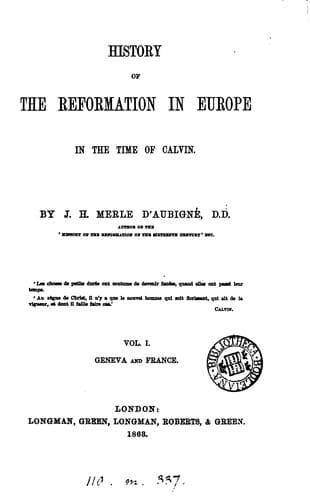
History of the Reformation in Europe in the Time of Calvin, Vol. 8 (of 8)Merle d'Aubigné, J. H. (Jean Henri)
History
History of the Reformation in Europe in the Time of Calvin, Vol. 8 (of 8)
Merle d'Aubigné, J. H. (Jean Henri)
Reformation
the question which is the head and whole content of all others objected
against me. This is both the helm and stern of both together.'[261]
There were forty-five points, and to these he made answer article by
article.[262] Shortly afterwards, in consequence of the death of Warham
and of Cranmer's appointment to the vacant see, the Antwerp chaplain
was set at liberty. He determined to remain in London, took, it seems,
from prudential considerations, the name of Lambert, and devoted
himself to the labors of a teacher, but at the same time adhered to the
resolution to avail himself of every opportunity of maintaining the
truth.
[Sidenote: HIS WORK ON THE LORD'S SUPPER.]
Being informed one day that Doctor Taylor was to preach at St. Peter's
Church, Cornhill, he went to hear him, not only because of his
well-known gifts, but also because he was not far from the Gospel. He
was later appointed bishop of Lincoln under pious King Edward, and
was deprived of that office under the fanatical Mary. Taylor preached
that day on the real presence of Christ in the bread and the wine.
Nicholson also believed, indeed, in the presence of the Lord in the
Supper, but this presence, he believed, was in the hearts of the
faithful. After the service he went to see Taylor, and with modesty
and kindliness urged various arguments against the doctrines which he
had been setting forth. 'I have not time just now,' said the doctor,
'to discuss the point with you, as other matters demand my attention;
but oblige me by putting your thoughts in writing and call again when
I am more at leisure.' Lambert applied himself to the task of writing,
and against the doctrine of the presence in the _bread_ he adduced ten
arguments, which were, says Fox, very powerful. It does not appear
that Taylor replied to them. He was an upright man, who gave impartial
consideration to these questions, and by Nicholson's reasoning he seems
to have been somewhat shaken. As Taylor was anxious to be enlightened
himself and to try to satisfy his friendly opponent, he communicated
the document to Barnes. The latter, a truly evangelical Christian, was
nevertheless of opinion that to put forward the doctrine of this little
work would seriously injure the cause of the Reformation. He therefore
advised Taylor to speak to Archbishop Cranmer on the subject. Cranmer,
who was of the same opinion, invited Nicholson to a conference, at
which Barnes, Taylor, and Latimer were also present. These four
divines had not at this time abandoned the view which the ex-chaplain
of Antwerp opposed: and considering the fresh revival of sacramental
Catholicism, they were not inclined to do so. They strove therefore to
change the opinion of the pious minister, but in vain. Finding that
they unanimously condemned his views, he exclaimed: 'Well then, I
appeal to the king.' This was a foolish and fatal appeal.
Public-domain text, read in full here on John Shaqi.
Reviews
Reviews
No reviews yet
Be the first to share your thoughts on this work.
Elsewhere in the archive
Join the Discussion
Join the discussion
Sign in to leave a comment or review.
Sign InorCreate an account