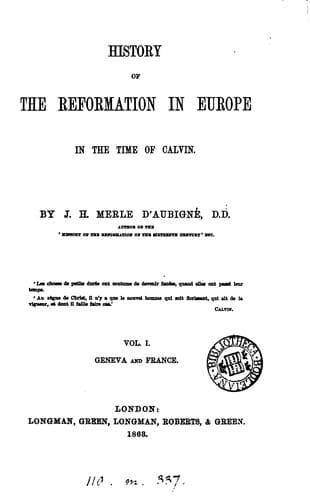
History of the Reformation in Europe in the Time of Calvin, Vol. 8 (of 8)Merle d'Aubigné, J. H. (Jean Henri)
History
History of the Reformation in Europe in the Time of Calvin, Vol. 8 (of 8)
Merle d'Aubigné, J. H. (Jean Henri)
Reformation
More than this, political circumstances were favorable to the
introduction of the Reformation. Spain was at this time under the same
sceptre as Germany and the Netherlands, and the rays of light emanating
from the Scriptures could not but reach it. The emperor Charles the
Fifth, who was fighting against the Reformation in Germany, was to
be the means of bringing it into the country of his very Catholic
ancestors. The young Alfonso Valdès, his secretary, who was with him
at Brussels in 1520, and afterwards at Worms in 1521, was at first
struck with horror at seeing the boldness with which Luther attacked
the authority of the pope. But what he saw and heard led him gradually
to comprehend the necessity for Reformation. Consequently, when writing
from Brussels and Worms to his friend Peter Martyr d'Anghiera, Valdès
sorrowfully exclaimed, 'While the pontiff shuts his eyes and desires
to see Luther devoured by the flames, the whole Christian community is
near its ruin, unless God save it.'[8]
Books more dangerous to Rome than those of Erasmus reached Spain. A
printer of Basel, the very year in which Charles was elected emperor
(1519), packed up carefully for transport beyond the Pyrenees some
precious merchandise not yet prohibited in the peninsula, because as
yet unknown there. It consisted of various Latin works of Luther.[9] In
1520 the 'Commentary on the Galatians,' and afterwards other writings
of the reformer, were translated into Spanish.[10] The union existing
between Spain and the Netherlands had led many Spaniards to settle in
the latter country, and it may possibly have been one of these who
translated them. It is at least certain that they were printed at
Antwerp, and that merchant vessels carried them thence into Spain.
Many noble minds were stirred up and became attentive to what was
passing in Germany. Francis de Angelis, provincial of the Order of
the Angeli, who had been present at the coronation of the emperor,
was still more enlightened than Valdès himself. Being sent back to
Spain after the Diet of Worms upon an important mission, he stopped
at Basel. There he visited Pellican, and in a conversation which he
had with him he showed himself almost in agreement with Luther.[11]
All these circumstances arousing the attention of Rome, Leo X. sent
(March 20, 1521) two briefs to Spain to demand that the introduction of
the books of the German reformer and his partisans into that country
should be checked; and Adrian VI., the successor of Leo, called upon
the government to assist the Inquisition in the accomplishment of this
duty.[12]
Public-domain text, read in full here on John Shaqi.
Reviews
Reviews
No reviews yet
Be the first to share your thoughts on this work.
Join the Discussion
Join the discussion
Sign in to leave a comment or review.
Sign InorCreate an account