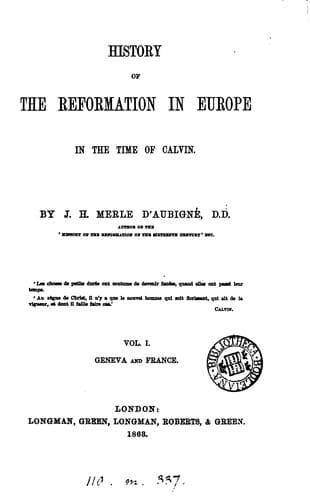
History of the Reformation in Europe in the Time of Calvin, Vol. 8 (of 8)Merle d'Aubigné, J. H. (Jean Henri)
History
History of the Reformation in Europe in the Time of Calvin, Vol. 8 (of 8)
Merle d'Aubigné, J. H. (Jean Henri)
Reformation
The company, according to the king's request, arrived at the
archbishop's palace, and Cranmer gave his guests an honorable
reception. The latter executed the king's commission, adding that
he must not be disheartened although the parliament had come to a
decision contrary to his opinion. Cranmer replied that 'he was obliged
to his majesty for his good affection, and to the lords for the pains
they have taken.' Then he added resolutely: 'I have hope in God that
hereafter my allegations and authorities will take place, to the glory
of God and commodity of the realm.' They sat down to table. Every guest
apparently did his best to make himself agreeable to the primate. 'My
lord of Canterbury,' said Cromwell, 'you are most happy of all men; for
you may do and speak what you list, and, say what all men can against
you, the king will never believe one word to detriment or hindrance.'
The meal, however, did not pass altogether so smoothly. The king had
brought together, in Cromwell and Norfolk, the most heterogeneous
elements; and the feast of peace was disturbed by a sudden explosion.
Cromwell, continuing his praises, instituted a parallel between
Cardinal Wolsey and the archbishop of Canterbury. 'The cardinal,' he
said, 'lost his friends by his haughtiness and pride; while you gain
over your enemies by your kindliness and your meekness.' 'You must
be well aware of that, my lord Cromwell,' said the duke of Norfolk,
'for the cardinal was _your master_.' Cromwell, stung by these words,
acknowledged the obligations under which he lay to the cardinal, but
added; 'I was never so far in love with him as to have waited upon him
to Rome if he had been chosen pope, as I understand, my lord duke, that
you would have done.' Norfolk denied this. But Cromwell persisted in
his assertion, and even specified a considerable sum which the duke
was to receive for his services as admiral to the new pope, and for
conducting him to Rome. The duke, no longer restraining himself, swore
with great oaths that Cromwell was a liar. The two speakers, forgetting
that they were attending a feast of peace, became more and more excited
and did not spare hard words. Cranmer interposed to pacify them. But
from this time these two powerful ministers of the king swore deadly
hatred to each other. One or other of them must needs fall.[294]
[Sidenote: CRANMER'S TIME-SERVING.]
Public-domain text, read in full here on John Shaqi.
Reviews
Reviews
No reviews yet
Be the first to share your thoughts on this work.
Elsewhere in the archive
Join the Discussion
Join the discussion
Sign in to leave a comment or review.
Sign InorCreate an account