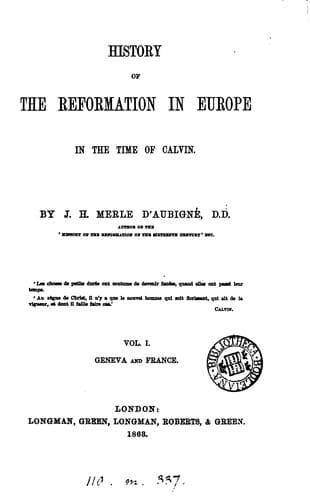
History of the Reformation in Europe in the Time of Calvin, Vol. 8 (of 8)Merle d'Aubigné, J. H. (Jean Henri)
History
History of the Reformation in Europe in the Time of Calvin, Vol. 8 (of 8)
Merle d'Aubigné, J. H. (Jean Henri)
Reformation
Latimer, bishop of Worcester, did more than Cranmer. On July 1, eight
days after the close of the session, he resigned his bishopric, and his
heart leaped for joy as he laid aside his episcopal vestments. 'Now I
am rid of a heavy burden,' he said, 'and never did my shoulders feel
so light.' One of his former colleagues having expressed his surprise,
he replied: 'I am resolved to be guided only by the Book of God, and
sooner than depart one jot from that, let me be trampled under the
feet of wild horses!' He now withdrew into the country, intending to
lead there a quiet life. He took care of his flowers and gathered his
fruit. Having had a fall from a tree, he found it necessary to return
to London for the purpose of procuring surgical attendance. When the
government was informed of this, orders were given to arrest and commit
him to the Tower, and there he remained till the king's death. Shaxton,
bishop of Salisbury, likewise resigned his see, on what grounds we
do not know. Under Queen Mary he became a violent persecutor. Many
evangelical Christians quitted England, and among them especially to
be noted are Hooper, Rogers, and John Butler.[293] Cranmer remained in
his archiepiscopal palace at Lambeth; but he sent away his wife and
children to his wife's relations in Germany.
This want of fidelity on Cranmer's part is only explicable on the
ground of the efforts made by Henry VIII. to retain him. On the day
of the prorogation of parliament, June 28, 1539, Henry, fearing lest
the archbishop, disheartened and distrusted, should offer to him his
resignation, sent for him, and, receiving him with all the graciousness
of manner which he knew so well how to assume when he wished, said: 'I
have heard with what force and learning you opposed the Six Articles.
Pray state your arguments in writing, and deliver the statement to
me.' Nor was this all that Henry did. Desirous that all men, and
particularly the adherents of Anglo-Catholicism should know the esteem
which he felt for the primate, he commanded the leader of this party,
the duke of Norfolk, his brother-in-law, the duke of Suffolk, Norfolk's
rival, Lord Cromwell, and several other lords to dine the next day
with the archbishop at Lambeth. You will assure him, he said, of my
sincere affection, and you will add that although his arguments did not
convince the parliament, they displayed much wisdom and learning.
[Sidenote: THE KING AND THE PRIMATE.]
Public-domain text, read in full here on John Shaqi.
Reviews
Reviews
No reviews yet
Be the first to share your thoughts on this work.
Elsewhere in the archive
Join the Discussion
Join the discussion
Sign in to leave a comment or review.
Sign InorCreate an account