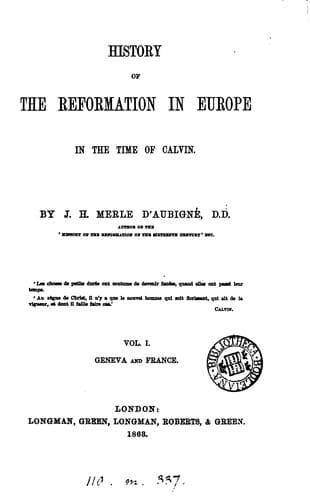
History of the Reformation in Europe in the Time of Calvin, Vol. 8 (of 8)Merle d'Aubigné, J. H. (Jean Henri)
History
History of the Reformation in Europe in the Time of Calvin, Vol. 8 (of 8)
Merle d'Aubigné, J. H. (Jean Henri)
Reformation
The violent thunder-clap which had suddenly pealed over England,
and occasioned so much trouble, was nowhere on the Continent more
unexpected, nowhere excited a greater commotion than at Wittenberg.
Bucer on one side, and several refugees arriving at Hamburg on the
other, had made known this barbarous statute to the reformers, and had
entreated the Protestants of Germany to interpose with Henry in behalf
of their fellow-religionists. Luther, Melanchthon, Jonas, and Pomeranus
met together, and were unanimous in their indignation. 'The king,'
they said, 'knows perfectly well that our doctrine concerning the
sacrament, the marriage of priests, and other analogous subjects, is
true. How many books he has read on the subject! How many reports have
been made to him by the most competent judges! He has even had a book
translated, in which the whole matter is explained, and he makes use
of this book every day in his prayers. Has he not heard and approved
Latimer, Cranmer, and other pious divines? He has even censured the
king of France for condemning this doctrine. And now he condemns it
himself more harshly than the king or the pope. He makes laws like
Nebuchadnezzar, and declares that he will put to death any one who does
not observe them. Great sovereigns of our day are taking it into their
heads to fashion for themselves religions which may turn to their own
advantage, like Antiochus Epiphanes of old. I have power, says the king
of England, to require that any one of my courtiers shall not marry
so long as he intends to remain at court; for the same reason I have
also power to forbid the marriage of priests. We are now entreated to
address remonstrances to this prince. The Scriptures certainly teach
us to endeavor to bring back the weak; but it requires that the proud
who compound with their conscience should be left to go in their own
way. It is clear that the king of England makes terms with conscience.
He has already been warned, and has paid no attention; there is,
therefore, no hope that he will listen to reason if he be warned anew.
Consider, besides, what kind of men those are in whose hands he places
himself. Look at Gardiner, who while exposing before all the nation
his scandalous connections (_liaisons_) dares to assert that it is
contrary to the law of God for a minister of God to have a lawful
wife.'[298]
[Sidenote: EXCITEMENT IN GERMANY.]
Public-domain text, read in full here on John Shaqi.
Reviews
Reviews
No reviews yet
Be the first to share your thoughts on this work.
Elsewhere in the archive
Join the Discussion
Join the discussion
Sign in to leave a comment or review.
Sign InorCreate an account