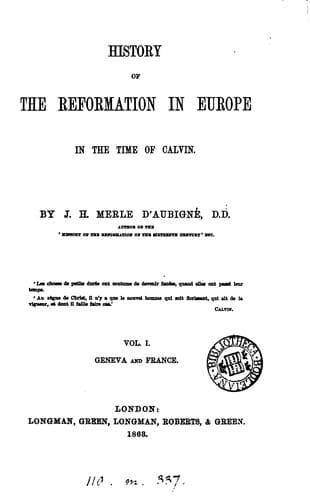
History of the Reformation in Europe in the Time of Calvin, Vol. 8 (of 8)Merle d'Aubigné, J. H. (Jean Henri)
History
History of the Reformation in Europe in the Time of Calvin, Vol. 8 (of 8)
Merle d'Aubigné, J. H. (Jean Henri)
Reformation
Henry had now been a widower for two years--a widower against his
will; for immediately after the death of Jane Seymour he had sought
in almost all quarters for a wife, but he had failed. The two great
Continental sovereigns had just been reconciled with each other, and
the emperor had even cast a slight upon the king of England in the
affair of the duchess of Milan. Henry was therefore now desirous of
contracting a marriage which should give offence to Charles, and should
at the same time win for himself allies among the enemies of that
potentate. Cromwell, for his part, felt the ground tremble under his
feet; Norfolk and Gardiner had confirmed their triumph by getting the
Six Articles passed. The vicegerent was therefore aiming to strengthen
at once his own position and that of the Reformation, both of them
impaired. Some have supposed it possible that his scheme was to unite
the nations of the Germanic race, England, Germany, and the North,
in support of the Reformation against the nations of the Latin race.
We do not think that Cromwell went so far as this. A young Protestant
princess, Anne, daughter of the duke of Cleves and sister-in-law of the
elector of Saxony, who consequently possessed both the religious and
the political qualifications looked for by the king and his minister,
was proposed to Henry by his ambassadors on the Continent, and Cromwell
immediately took the matter in hand. This union would bring the king
of England into intimate relations with the Protestant princes, and
would ensure, he thought, the triumph of the Reformation in England,
for Henry's wives appeared to have great influence over him, at least
so long as they were in favor. Henry was, however, seeking something
more in his betrothed than diplomatic advantages. Cromwell knew this,
and did not fail to make use of that argument. 'Every one praises the
beauty of this lady,' he wrote to the king (March 18, 1539), 'and it is
said that she surpasses all other women, even the duchess of Milan. She
excels the latter both in the features of her countenance and in her
whole figure as much as the golden sun excelleth the silver moon.[304]
Her portrait shall be sent you. At the same time, every one speaks
of her virtue, her chastity, her modesty, and the seriousness of her
aspect.' The portrait of Anne, painted by Holbein, was presented to
the king, and it gave him the idea of a lady not only very beautiful,
but of tall and majestic stature. He was charmed and hesitated no
longer. On September 16, the Count Palatine of the Rhine and other
ambassadors of the elector of Saxony and the duke of Cleves arrived
at Windsor. Cromwell having announced them to the king, the latter
desired his minister to put all other matters out of his head, saving
this only.[305] The affair was arranged, and the ambassadors on their
departure received magnificent presents.
Public-domain text, read in full here on John Shaqi.
Reviews
Reviews
No reviews yet
Be the first to share your thoughts on this work.
Elsewhere in the archive
Join the Discussion
Join the discussion
Sign in to leave a comment or review.
Sign InorCreate an account