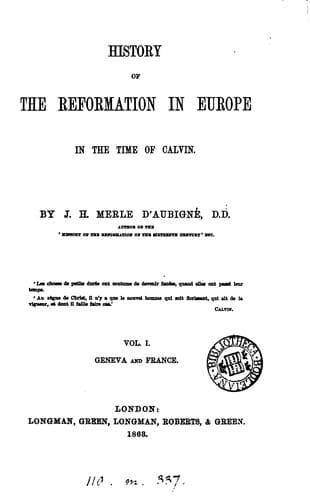
History of the Reformation in Europe in the Time of Calvin, Vol. 8 (of 8)Merle d'Aubigné, J. H. (Jean Henri)
History
History of the Reformation in Europe in the Time of Calvin, Vol. 8 (of 8)
Merle d'Aubigné, J. H. (Jean Henri)
Reformation
There was one point on which Henry did incline rather to Cranmer's
side; this was auricular confession. Perhaps he dreaded it on political
grounds. Now the bishops were urgent for its universal adoption, and
Tonstall wrote to the king on the subject. Henry rejected his demand
and called him a self-willed man. He seemed thus to draw towards
reconciliation with his primate. Nor was this all. A bill had passed
withdrawing heretics from the jurisdiction of the bishops, and
subjecting them to the secular courts. The chancellor, supported by
Cranmer, Cromwell, and Suffolk, and with the sanction of the king, set
at liberty the five hundred persons who had been committed to prison.
The thunderbolt had indeed trenched the seas, but nobody was hurt--at
least for the moment.[302]
[Sidenote: THE MOCK SEA-FIGHT.]
Henry resorted to other means for the purpose of reassuring those
who imagined that the pope was already re-established in England. He
exhibited to the citizens of London the spectacle of one of those
sea-fights, on which the ancient Romans used to lavish such enormous
sums. Two galleys, one of them decorated with the royal ensigns, the
other with the papal arms, appeared on the Thames, and a naval combat
began. The two crews attacked each other; the struggle was sharp and
obstinate; at length the soldiers of the king boarded the enemy and
threw into the water amidst the shouts of the people an effigy of the
pope and images of several cardinals. The pontifical phantom, seized by
bold hands, was dragged through the streets; it was hung, drowned, and
burnt.[303] It would have been better for the king to let alone such
puerile and vulgar sports, which pleased none but the mob, and to give
more serious proofs of his attachment to the Gospel.
CHAPTER IV.
HENRY VIII. AND ANNE OF CLEVES.
(1539-1540.)
At the period which we have now reached, Henry VIII. displayed in a
more and more marked manner that autocratic disposition which submits
to no control. He lifted up or cast down; he crowned men with honors
or sent them to the scaffold. He pronounced things white or black
as suited him, and there was no other rule but his own absolute and
arbitrary power. A simple and modest princess was one of the first to
learn by experience that he was a despot in his family as well as in
church and state.
[Sidenote: ANNE OF CLEVES.]
Public-domain text, read in full here on John Shaqi.
Reviews
Reviews
No reviews yet
Be the first to share your thoughts on this work.
Elsewhere in the archive
Join the Discussion
Join the discussion
Sign in to leave a comment or review.
Sign InorCreate an account