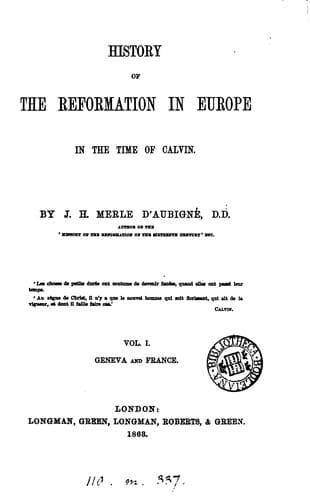
History of the Reformation in Europe in the Time of Calvin, Vol. 8 (of 8)Merle d'Aubigné, J. H. (Jean Henri)
History
History of the Reformation in Europe in the Time of Calvin, Vol. 8 (of 8)
Merle d'Aubigné, J. H. (Jean Henri)
Reformation
presents he had bestowed upon him.'[331] Besides, was it not the custom
of the ancients to crown their victims with flowers before sacrificing
them?
Henry was greedy of money, and was in want of it, for he spent it
prodigally. He applied to Cromwell for it. The latter was aware that in
making himself the king's instrument in this matter he was estranging
from himself the mind of the nation; but he considered that a great
sovereign must have great resources, and he was always willing to
sacrifice himself for the king, for to him he owed every thing, and
he loved him in spite of his faults. On April 23, four days after
receiving from the king such extraordinary favors, Cromwell proposed to
the house to suppress the Knights of St. John of Jerusalem, and urged
that their estates, which were considerable, should be given to the
king. This was agreed to by parliament. On May 3 he demanded for his
majesty a subsidy of unparalleled character, namely, four tenths and
fifteenths, in addition to ten per cent. on the rents of lands and five
per cent. on the value of merchandise. This also he obtained. Next he
went to the convocation of the clergy, and claimed from them two tenths
and twenty per cent. on ecclesiastical revenues for two years. Again he
succeeded. By May 8 the king had obtained through Cromwell's energy all
that he wished for.
[Sidenote: THE KING'S LETTER TO HIM.]
On the very next day, Sunday, May 9, Cromwell received in his palace a
note from the king thus worded:[332]
'HENRY R.
'By the King.
'Right trusty and well beloved cousin,--We greet you well;
signifying unto you our pleasure and commandment is that
forthwith, and upon the receipt of these our letters, setting
all other affairs apart, ye do repair unto us, for the treaty
of such great and weighty matters as whereupon doth consist
the surety of our person, the preservation of our honor, and
the tranquillity and quietness of you, and all other our
loving and faithful subjects, like as at your arrival here ye
shall more plainly perceive and understand. And that ye fail
not hereof, as we specially trust you.
'Given under our signet, at our manor of Westminster, the 9th
day of May.'
Public-domain text, read in full here on John Shaqi.
Reviews
Reviews
No reviews yet
Be the first to share your thoughts on this work.
Elsewhere in the archive
Join the Discussion
Join the discussion
Sign in to leave a comment or review.
Sign InorCreate an account