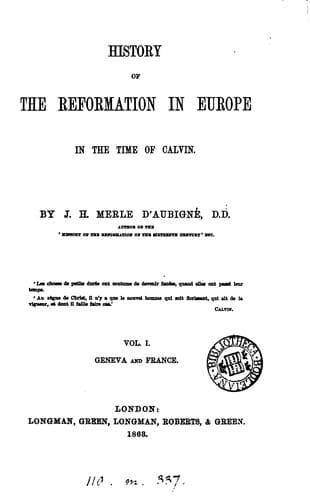
History of the Reformation in Europe in the Time of Calvin, Vol. 8 (of 8)Merle d'Aubigné, J. H. (Jean Henri)
History
History of the Reformation in Europe in the Time of Calvin, Vol. 8 (of 8)
Merle d'Aubigné, J. H. (Jean Henri)
Reformation
What could this urgent and mysterious note mean? Cromwell could not
rest after reading it. 'The surety of our person, the preservation of
our honor' are in question, said the king. We may imagine the agitation
of his mind, his fears as to the result of the visit, and the state
of perplexity in which, without losing a minute, he went in obedience
to the king's command. We have no information as to what passed at
this interview. Probably the minister supposed that he had justified
himself in his master's sight. On the following day, Monday, the earl
of Essex was present as usual in the House of Lords and introduced a
bill. The day after, parliament was prorogued till May 25. What could
be the reason for this? It has been supposed that Cromwell's enemies
wished to gain the time needful for collecting evidence in support of
the charges which they intended to bring against him. When the fifteen
days had elapsed, parliament met again, and the earl of Essex was in
his place on the first and following days. He was still in the assembly
as minister of the king on June 10, on which day, at three o'clock,
there was a meeting of the Privy Council. The duke of Norfolk, the earl
of Essex, and the other members were quietly seated round the table,
when the duke rose and accused Cromwell of high treason. Cromwell
understood that Norfolk was acting under the sanction of the king, and
he recollected the note of May 9. The lord chancellor arrested him and
had him conducted to the Tower.[333]
[Sidenote: CHARGES AGAINST CROMWELL.]
Public-domain text, read in full here on John Shaqi.
Reviews
Reviews
No reviews yet
Be the first to share your thoughts on this work.
Elsewhere in the archive
Join the Discussion
Join the discussion
Sign in to leave a comment or review.
Sign InorCreate an account