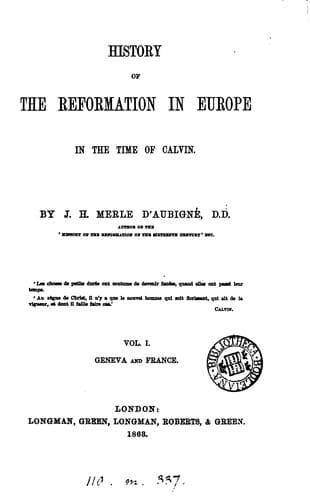
History of the Reformation in Europe in the Time of Calvin, Vol. 8 (of 8)Merle d'Aubigné, J. H. (Jean Henri)
History
History of the Reformation in Europe in the Time of Calvin, Vol. 8 (of 8)
Merle d'Aubigné, J. H. (Jean Henri)
Reformation
Nothing could be more at variance with the character and the whole
life of Cromwell than the foolish sayings attributed to him. Every
intelligent man might see that they were mere falsehoods invented by
the Catholic party to hide its own criminal conduct. But at the same
time it most clearly pointed out in this letter the real motive of
the blow aimed at Cromwell, the first, true, efficient cause of his
fall, the object which his enemies had in view and towards which they
were working. They fancied that the overthrow of Cromwell would be
the overthrow of the Reformation. Wallop did not fail to impart the
information to the court to which he was accredited; and Henry VIII.
was delighted to hear of 'the friendly rejoyce of our good brother the
French king, the constable and others there,' on learning the arrest of
the lord privy seal.[335] This rejoicing was very natural on the part
of Francis I., Montmorency, and the rest of them.
[Sidenote: CRANMER'S PLEA FOR HIM.]
As soon as the arrest of June 10 was known, the majority of those who
had most eagerly sought after the favor of Cromwell, and especially
Bonner, bishop of London, immediately turned round and declared
against him. He had gained no popularity by promoting the last bills
passed to the king's advantage; and the news of his imprisonment was
therefore received with shouts of joy.[336] In the midst of the general
defection, one man alone remained faithful to the prisoner--this was
Cranmer. The man who had formerly undertaken the defence of Anne Boleyn
now came forward in defence of Cromwell. The archbishop did not attend
the Privy Council on Thursday, June 10; but being in his place on the
Friday, he heard that the earl of Essex had been arrested as a traitor.
The tidings astonished and affected him deeply. He saw in Cromwell
at this time not only his personal friend, not only the prudent and
devoted supporter of the Reformation, but also the ablest minister and
the most faithful servant of the king. He saw the danger to which he
exposed himself by undertaking the defence of the prisoner; and he felt
that it was his duty not recklessly to offend the king. He therefore
wrote to him in a prudent manner, reminding him, nevertheless,
energetically, of all that Cromwell had been. His letter to the king
was written the day after he heard of the fall of the minister. 'I
heard yesterday in your grace's council,' he says, 'that he [Cromwell]
is a traitor; yet who can not be sorrowful and amazed that he should
be a traitor against your majesty, he that was so advanced by your
majesty; he whose surety was only by your majesty; he who loved your
majesty (as I ever thought) no less than God; he who studied always
to set forwards whatsoever was your majesty's will and pleasure; he
that cared for no man's displeasure to serve your majesty; he that was
such a servant, in my judgment, in wisdom, diligence, faithfulness,
and experience, as no prince in this realm ever had; he that was so
Public-domain text, read in full here on John Shaqi.
Reviews
Reviews
No reviews yet
Be the first to share your thoughts on this work.
Elsewhere in the archive
Join the Discussion
Join the discussion
Sign in to leave a comment or review.
Sign InorCreate an account